US AI labs may be in trouble
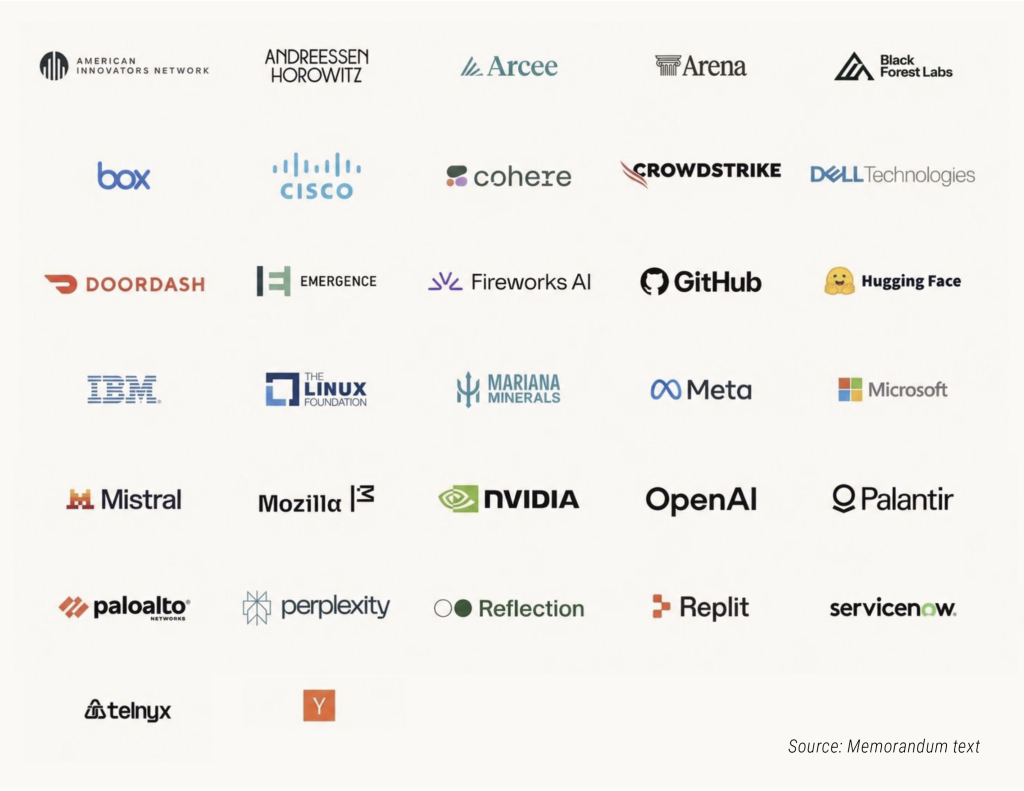
The statement published on 24 July marked the culmination of the debate on open- and closed-weight models that had intensified with the arrival of the Chinese AI model Kimi K3. With a few exceptions, the leading players of the American tech and AI sector came out in support of open models.
Open Weights and American AI Leadership memorandum signatories
With closed-weight models the developer does not release the trained parameters, and typically discloses neither the architecture, nor the parameter count, nor the training data. The model is accessible only through an API or an application and cannot be run on your own infrastructure. This gives the developer a strong bargaining position: it can withdraw a model at any time, update it quietly, reprice it or tighten the terms. This is how every leading model of the Western frontier labs works, and companies often pay millions of dollars for that exclusivity.
With open-weight models the parameters can be downloaded, and usually the architecture is public as well. This reverses the bargaining position, since what has once been downloaded cannot be taken away, the version can be frozen, and the provider cannot unilaterally reprice or withdraw it. This is how Llama, Mistral, DeepSeek and Qwen work. The best open-weight models set the price ceiling, because a premium can be charged for a closed model only for as long as the capability gap justifies it.
On 20 July the American news site Axios reported that the administration had revived plans to ban leading Chinese models on cybersecurity grounds. Since then Moonshot AI, the Beijing-based developer of Kimi K3, has been accused of large-scale, covert industrial distillation, by copying the best models of the leading American lab Anthropic using smuggled Nvidia accelerators. This would not be unprecedented, since earlier this year Anthropic reported that DeepSeek, Moonshot and Shanghai-based MiniMax had collected more than 16 million Claude responses in distillation campaigns. According to Moonshot’s own measurements, K3 sits confidently in the leading group and on some benchmarks is the most capable model in the world, ahead of Claude Mythos and GPT 5.6 Sol class models. This has largely been confirmed by independent testers such as Artificial Analysis. Demand for the model soon exceeded Moonshot’s capacity to such an extent that the lab suspended registration for new subscribers.
Ranking of the smartest AI models (28.07.2026.)
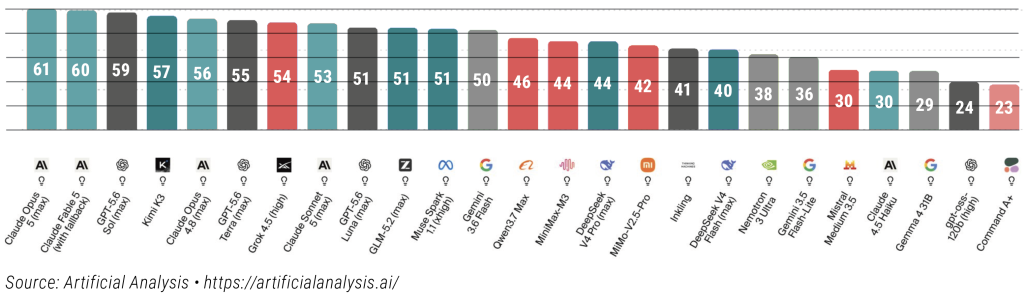
The question is this: if a Chinese AI lab with orders of magnitude less capital and a constrained chip supply can deliver a model with frontier-level capabilities and then give away its parameter weights for free, what justifies the trillion-dollar valuations of the leading, closed Western labs?
K3’s API pricing is roughly 70% lower than Anthropic’s best. The model itself is huge, at around 2.8 trillion parameters, but thanks to the MoE architecture, which works with many smaller expert sub-models, it uses on average only 50 billion active parameters while making predictions based on learned patterns and logic. Its per-token compute requirement matches that of a 50-billion-parameter dense model, so at pricing of $15 per million output tokens the gross margin on the API is presumably healthy.
The signatories of the memorandum supporting open AI models include the cream of the American AI world: Nvidia, Meta, Microsoft, IBM, Dell, Palantir, several venture capital investors, Elon Musk and David Sacks (the White House AI adviser). With a slight delay, OpenAI and Google also joined the illustrious list. They all argue that open-weight models play an important role both in terms of cybersecurity and in keeping the AI race alive, and that by banning Chinese models the two leading American AI labs would in fact be stifling their competitors.
Those who regard Chinese open models as a threat are led by Anthropic, but this position is also supported by Amazon, a major player in cloud-based AI, by several leading figures at OpenAI such as president and co-founder Greg Brockman, and by a large share of AI safety researchers. In their view, releasing frontier open models freely carries serious dangers, because in the wrong hands they can be used for cyberattacks and fraud. When we use a model from a Western frontier lab, numerous filters typically restrict harmful behaviour. Anyone with access to the full weights and code of the model, however, can remove those restrictions, and the model will no longer refuse malicious requests.
In addition, the accusation still stands against Moonshot that its models were created at least in part “with the help of” Western frontier models. The opposing camp regards this practice as theft of intellectual property. Model distillation is far cheaper than conventional training. Its essence is that a smaller, and therefore cheaper, model is trained on the responses of a model with a larger parameter count, so that it achieves similar capability. This can have a severe deterrent effect on the frontier labs, since they spend tens of billions of dollars on training, which other players then copy, offering incrementally weaker but an order of magnitude cheaper alternatives to their models. A parallel can be drawn between pharmaceutical drug development and the development of frontier AI models. To encourage the development of new active substances, the established practice is multi-year patent protection and the manufacturing exclusivity that follows from it for the developer. If a compound developed at a cost of several billion dollars had to compete with generic alternatives within weeks or months, nobody would consider it worthwhile, to embark on the development. It is no different with AI models.
Progress in open weights vs. proprietary intelligence
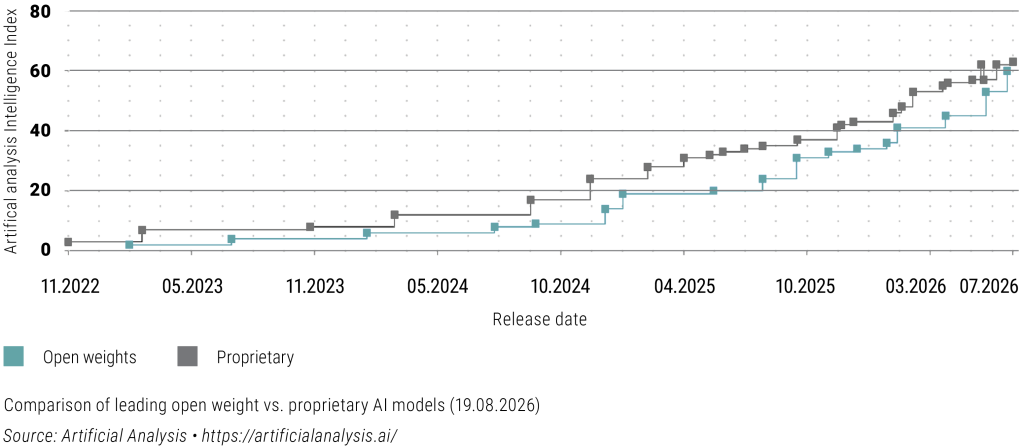
The gap between open-weight models and the leaders has narrowed to a few points on the main benchmarks, and in time to just a few months. If we add that the pace of model releases at the closed labs is of the same order of magnitude, the difference is practically imperceptible.
This is a marketing communication. Making a well-informed investment decision requires obtaining detailed information. Please read the Key Information Document, the official prospectus, and the management regulations available at the distribution points of the Fund and on the website of the Fund Manager (www.vigam.hu) for detailed information regarding the Fund’s investment policy, distribution costs, and the possible risks of investing. Costs related to the distribution of the investment fund (purchase, holding, sale) can be found in the Fund’s management regulations and at the distribution points. Past performance is not a reliable indicator of future returns. Future returns from the investment may be subject to taxation, and tax and duty information relating to individual financial instruments and transactions can only be accurately assessed based on the individual circumstances of each investor, which may change in the future. It is the investor’s responsibility to obtain information regarding tax obligations.
The data contained in this information material are provided for informational purposes only and do not constitute investment advice, an offer, or investment consulting. VIG Investment Fund Management Hungary Ltd. accepts no liability for investment decisions made based on this information or for their consequences. The license number of the Fund Manager for alternative investment fund management (AIFM) is: H-EN-III-6/2015. The license number of the Fund Manager for UCITS fund management (collective portfolio management) is: H-EN-III-101/2016.