The model portfolios have been constructed based on the VIG Investment Clock and our tactical asset allocation strategy, using following principles: we have selected 4-5 investment funds from our own range.
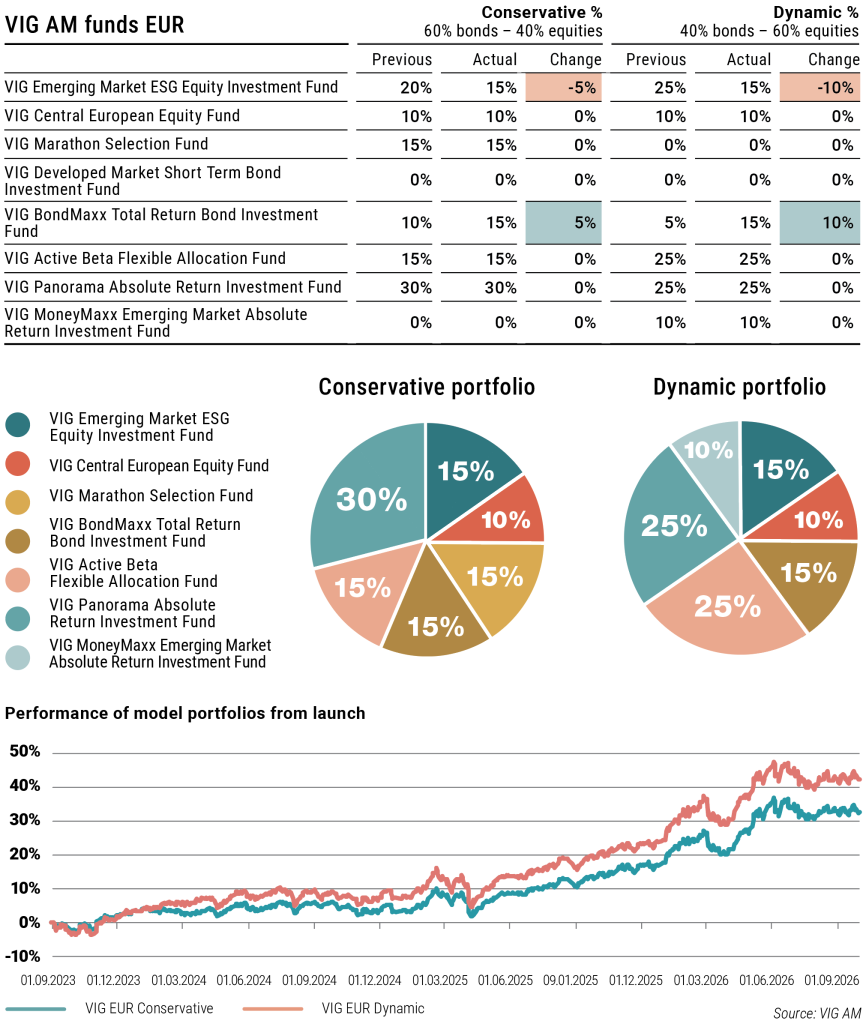
In all three currencies, the Conservative Portfolio targets a composition of 40% equities and 60% bonds, while the Dynamic Portfolio focuses on 60% equities and 40% bonds. The key economic factors behind these allocations include global and regional economic trends, expectations of central bank interest rate cuts, and investor sentiment.
Conservative portfolio focuses more on stability and fixed income assets (bonds), whereas dynamic portfolios aim for higher-yield outlook, using the volatility of equities. Conservative portfolios tend to focus on stability and safer assets (bonds), while aggressive portfolios rely on higher-yielding but riskier equities. In its investment decisions, VIG Fund Management pays close attention to sustainability, particularly in ESG and sustainable funds.*
Investment Approach
The VIG Global Investment Clock, a scientifically grounded indicator-based tool for forecasting economic cycles, presents a mixed outlook for the coming months. The world’s three major economic regions – the United States, Europe and China – are currently at different stages of the cycle.
In the United States, the indicator has moved from a neutral stagflationary position into the expansion phase, characterised by stronger growth and higher inflation. Meanwhile, slightly better growth figures have pushed the European Union into the overheating phase. Improvements in growth data and economic activity are being driven primarily by AI-related investment in the United States. However, substantial volatility in oil prices is also creating considerable fluctuations in the leading indicators. The movements of the Investment Clock highlight just how uncertain and fast-changing the macroeconomic environment remains.
Investing need not be limited to the Hungarian forint. Euro- and US dollar-denominated portfolios may also offer attractive opportunities if the forint weakens.
VIG EUR Portfolios
We made similar adjustments to both of our euro-denominated model portfolios, which have different risk profiles. We increased the weighting of the VIG BondMaxx Total Return Bond Investment Fund by 5 percentage points in the more cautious Conservative portfolio and by 10 percentage points in the more adventurous Dynamic portfolio. The fund stands to benefit from the high coupon rates and real yields currently available in developed markets.
Conversely, we reduced the allocation to the VIG Emerging Markets ESG Equity Investment Fund, which has significant exposure to Asian technology stocks. Although valuations in Asian markets remain attractive relative to other regions, our investment specialists believe that higher macroeconomic and currency risks justify a measured reduction in exposure.
VIG USD Portfolios
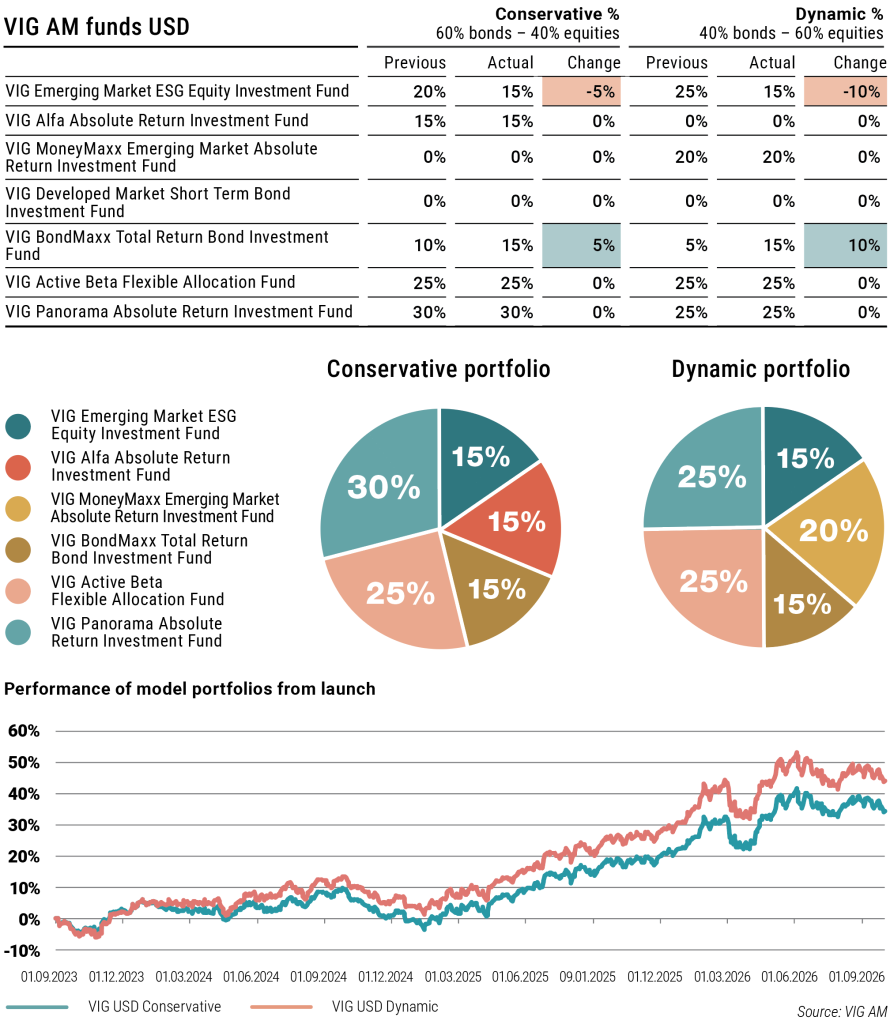
We made the same adjustments to our US dollar portfolios as to the euro-denominated portfolios. Our more cautious stance towards the VIG Emerging Markets ESG Equity Investment Fund reflects some reservations about the share prices of Asian companies, particularly those benefiting from the AI boom. Operating margins at South Korean chipmakers have risen from around 40% to more than 80% on the back of AI-related demand. Although valuations remain low, investors are increasingly questioning how long such exceptionally high profits can be sustained. Here too, we reallocated the proceeds to the actively managed VIG BondMaxx Total Return Bond Investment Fund.
The rationale is the same as for the HUF and EUR portfolios: yields near multi-year highs and elevated real interest rates could favour the longer-duration bonds held by the VIG BondMaxx Total Return Bond Investment Fund. The portfolios’ largest holdings, however, remain unchanged. The VIG Panorama Absolute Return Investment Fund provides a measure of protection against inflation, while the VIG Active Beta Flexible Allocation Fund contributes to portfolio performance through selected developed-market equity investments.
Detailed information on the consideration of sustainability aspects is available on our website: https://www.vigam.hu/en/esg-investments/
Disclaimer
This is a distribution announcement. Detailed information is needed to make a well-founded investment decision. Please inform yourself thoroughly regarding the Fund’s investment policy, potential investment risks and distribution in the Fund’s key investment information, official prospectus and management regulations available at the Fund’s distribution outlets and on the website of VIG Asset Management Hungary Closed Company Limited by Shares (hereinafter: Asset Management) (vigam.hu). The costs related to the distribution of the fund (buying, holding, selling) can be found in the fund’s management regulations and at the distribution outlets. Past returns do not predict future performance. Please note that in comparison with other investment funds, the return achieved may be affected by differences in the reference index and therefore the investment policy.
The future performance that can be achieved by investing may be subject to tax, and the tax and duty information relating to specific financial instruments and transactions can only be accurately assessed on the basis of the individual circumstances of each investor and may change in the future. It is the responsibility of the investor to inform himself about the tax liability and to make the decision within the limits of the law.
The information contained in this leaflet is for informational purposes only and does not constitute an investment recommendation, an offer or investment advice. Asset Management accepts no liability for any investment decision made on the basis of this information and its consequences.
This leaflet may contain trade names or brand names owned by third parties, the use of which serves illustration purposes only. All product and company names are trademarks™ or registered trademarks® of their respective owners. The use of such trademarks does not imply any business or other relationship between Asset Management and the owners of the trademarks, nor shall it be interpreted as a recommendation by Asset Management.
The Asset Management’s license number for managing alternative investment funds (AIFM) is: H-EN-III-6/2015. The Asset Management’s license number for UCITS fund management (collective portfolio management) is: H-EN-III-101/2016.