The central bank of AI
On the evening of 10 August, Nvidia announced that it had signed letters of intent with six large financial institutions on the creation of so-called “compute financing” platforms.
The partners are the asset managers Apollo, BlackRock, Blackstone, Brookfield and Kohlberg Kravis Roberts & Co. (KKR), along with the investment bank Goldman Sachs. The goal is to mobilise more than $500 billion of third-party capital for AI infrastructure. Jensen Huang, Nvidia’s chief executive, wants to turn the AI accelerators sold by his company (these are specialised hardware devices that perform artificial intelligence, machine learning and neural network computations far faster than conventional processors) and chip systems – and, in a broader sense, computing capacity itself – into an investable asset class.
Guarantees and credit support
It is not unprecedented for Nvidia or another large AI infrastructure player to reach for creative financing methods. These typically have two purposes. One is to improve, through the provision of guarantees, a third party’s (often its own customer’s) ability to raise capital and the terms on which it can do so. The other is to boost short-term demand for chips through direct vendor financing and product-for-equity swaps. On the supplier side, Nvidia and its main American rival AMD are the biggest users of these techniques. At the other end of the chain stand the NeoCloud companies (specialised cloud providers optimised expressly for training and running large AI models) such as CoreWeave, Nebius and IREN, along with frontier AI labs such as OpenAI and Anthropic, they are the beneficiaries of these structures. Meta, the owner of Facebook, and Oracle, a leader in database management, form a separate category. These companies use SPVs (special purpose vehicles) to finance expensive hardware and the associated loans off their own balance sheets. The purpose of the SPVs is to keep these off the balance sheets of tech giants that operate with relatively few physical assets of their own, such as real estate, machinery or data centres.
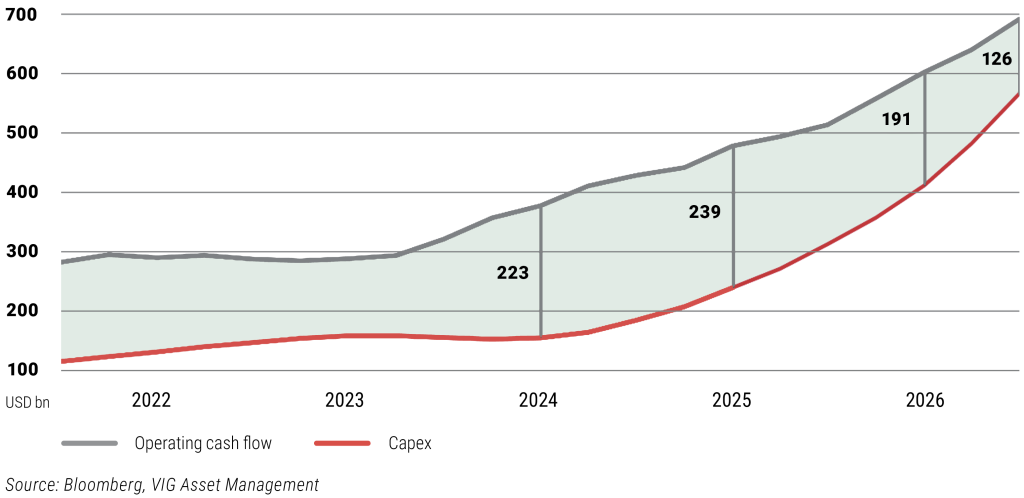
The overwhelming majority of the AI build-out has so far been funded from the operating cash flow of the hyperscalers mentioned above, but over the past year this appears to be reversing. First at Oracle, then at Meta, and by now at Google too, free cash flow, which could be the engine of further AI investment, is approaching zero. The new financing platforms offer a solution to this.
The end of hyperscaler self-funding
Aggregate LTM operating cash flow and capex, MSFT, GOOGL, AMZN, META, ORCL
This time the money comes not from Nvidia’s own cash flow but primarily from insurers, pension funds and retail wealth reached through bank distribution. Guarantees are crucial here as well. An insurer can hardly buy speculative assets to cover its annuity liabilities, so securitised computing capacity has to be of IG (investment grade) quality. A NeoCloud company on its own carries a weaker (“sub-IG”) rating, so through its guarantees Nvidia lends its own AA/Aa1 rating in order to make these securities representing computing capacity sellable. Even though the money comes from external players, Nvidia’s guarantee burden grows further as a result.
Customer concentration is also an important consideration for Nvidia. From the latest quarterly reports we know that four direct customers (not named individually) accounted for more than 60% of revenues. Direct customers are typically manufacturers and system integrators, but behind them stand the same hyperscaler companies as indirect buyers, the ones talking in their own reports about capital expenditure running into the hundreds of billions. The declared aim of the backstop guarantee programmes and the new financing platforms is to open up the compute market beyond the large hyperscalers and AI labs. The current customer base is increasingly focused on developing and using its own chips so that it does not have to pay Nvidia’s enormous margin. For Nvidia, the new platform is also a form of defence against an increasingly less loyal customer base developing TPU, Trainium and MTIA, proprietary hardware accelerators specialised for artificial intelligence and developed by the world’s largest technology giants.
Pricing chaos in the market for computing capacity
Estimates suggest that by 2029 there could be more than $7 trillion of AI debt outstanding, which would make it the world’s second largest asset-backed credit market after the US mortgage market ($13 trillion). According to the latest figures, annual AI capex will be well above $2 trillion in 2028, while cumulative capex between 2024 and 2029 will reach $11 trillion. The primary source of this may be the credit market.
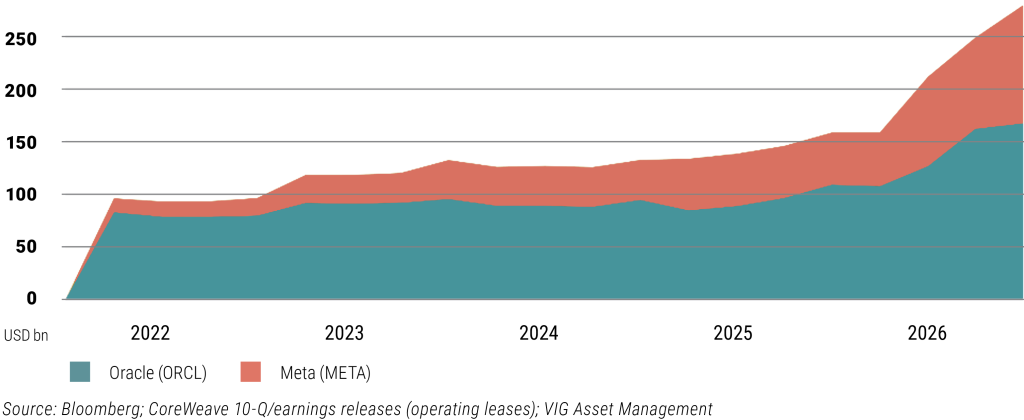
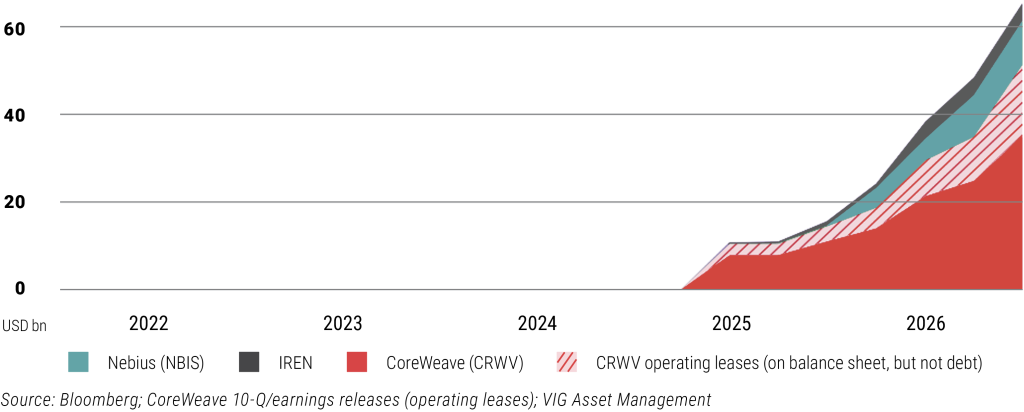
The rise of AI debt
Quarterly total debt; CoreWeave includes operating lease liabilities
Hyperscalers
NeoCloud providers
One would therefore assume that the market in question has a mature pricing methodology, standardised futures products and a transparent market picture, like other mature asset classes of a similar trillion-dollar scale. That is not the case. There is no standard GPU rental price index, deals are bilateral, and no derivatives market exists.
The example of xAI illustrates the situation well. In May, Anthropic contracted for the entire capacity of Colossus 1 for $1.25 billion a month, while in June Google contracted for roughly 110,000 GPUs (graphics chips) for $920 million a month. For Google this works out at about $11.5 per GPU per hour. In Anthropic’s case the figure depends on the source, because the GPU count is variously put at between 220,000 and 325,000, so the implicit price ranges from $5.3 to $7.8. The top of the pricing range is double the bottom even for the same provider. Pricing depends primarily on the mix of GPU generations and the CPU-GPU-memory configuration, but the details are often not public, or can only be reverse-engineered with difficulty. The market for computing capacity is not transparent. The various cloud providers all lease out their capacity on markedly different terms and at different prices.
Wrong-way risk
And this is where things start to become worrying. Nvidia’s guarantee becomes callable at precisely the moment when the collateral behind it is worth the least. If AI demand slows, the secondary market value of GPUs falls, the cash flow of the NeoClouds deteriorates and the guarantees all fall due at once. Credit market terminology calls this wrong-way risk. Nvidia is essentially writing a put option on the residual value of its own product, and this position turns short exactly when its own fundamentals are weakening too. As long as the guarantees are not called, they sit as off-balance-sheet contingent liabilities, so they do not show up in the balance sheet total. With expected revenue of roughly $216 billion and free cash flow of $97 billion for 2026, today’s scale is still comfortably bearable, but this buffer does not scale together with the size of the platform. If the exposure grows materially, the first signal will come not from the rating agencies but from Nvidia’s CDS spread (credit default swap premium) and the spread of its bonds over Treasuries. These are worth watching, because the credit market reprices structural risk faster than the equity market.
Another important question is what revenue actually measures. If Nvidia uses a guarantee to make a buyer financeable and that buyer then purchases chips from it, then part of the sales volume reflects not independent demand but Nvidia’s own willingness to extend credit. The problem is that part of what the market sees as genuine demand is in fact driven by easily available financing. The two are almost impossible to separate from the outside, because Nvidia does not disclose what share of its revenues is backed by financial guarantees or other collateral.
Finally, a systemic observation
The structure creates strong mutual dependence between Nvidia and the AI ecosystem. As long as the market is growing, this benefits everyone. If, however, overcapacity develops, the large cloud providers will rein in their investments, the revenues of the NeoCloud companies will fall, and demand for Nvidia’s chips will decline as well. That is precisely when the guarantees undertaken by Nvidia may be triggered: the company would have to rescue partners whose failure would further reduce its own revenues. In other words, the entire system can start moving downwards at the same time. Nvidia may be the “central bank” of the AI market, but unlike a real central bank it cannot create money.
The sharing of risk is also only partly real. Within a few years, banks, SPVs and several hundred billion dollars of financing may all rest on the same fundamental risk: the durability of demand for AI infrastructure and, ultimately, Nvidia’s financial strength. In the short term this does not represent a direct danger, but the vulnerable structure is already taking shape and the guarantee mechanism is up and running. This is why in earlier analyses we called the NeoCloud providers the most unstable dominoes of the AI boom, and the latest developments reinforce that view.
Return DownloadThis is a marketing communication. Making a well-informed investment decision requires obtaining detailed information. Please read the Key Information Document, the official prospectus, and the management regulations available at the distribution points of the Fund and on the website of the Fund Manager (www.vigam.hu) for detailed information regarding the Fund’s investment policy, distribution costs, and the possible risks of investing. Costs related to the distribution of the investment fund (purchase, holding, sale) can be found in the Fund’s management regulations and at the distribution points. Past performance is not a reliable indicator of future returns. Future returns from the investment may be subject to taxation, and tax and duty information relating to individual financial instruments and transactions can only be accurately assessed based on the individual circumstances of each investor, which may change in the future. It is the investor’s responsibility to obtain information regarding tax obligations.
The data contained in this information material are provided for informational purposes only and do not constitute investment advice, an offer, or investment consulting. VIG Investment Fund Management Hungary Ltd. accepts no liability for investment decisions made based on this information or for their consequences. The license number of the Fund Manager for alternative investment fund management (AIFM) is: H-EN-III-6/2015. The license number of the Fund Manager for UCITS fund management (collective portfolio management) is: H-EN-III-101/2016.