The black box opens
Soon we may get a glimpse behind the gates of the most important company of the AI trend. Claude developer Anthropic is now unquestionably leading the race among frontier labs, and the company plans to take its shares public in 2026. The entire data-center building frenzy we are seeing today rests on the usefulness and profitability of AI, yet there is an embarrassing lack of transparency regarding the numbers underpinning the labs’ activities. From leaked and official data one can piece together a time series of the magnitude and growth of revenues, but that is about where the list of readily trackable financial metrics ends.
Anthropic overtook OpenAI in revenue in spring 2026
Annualized revenue run-rate
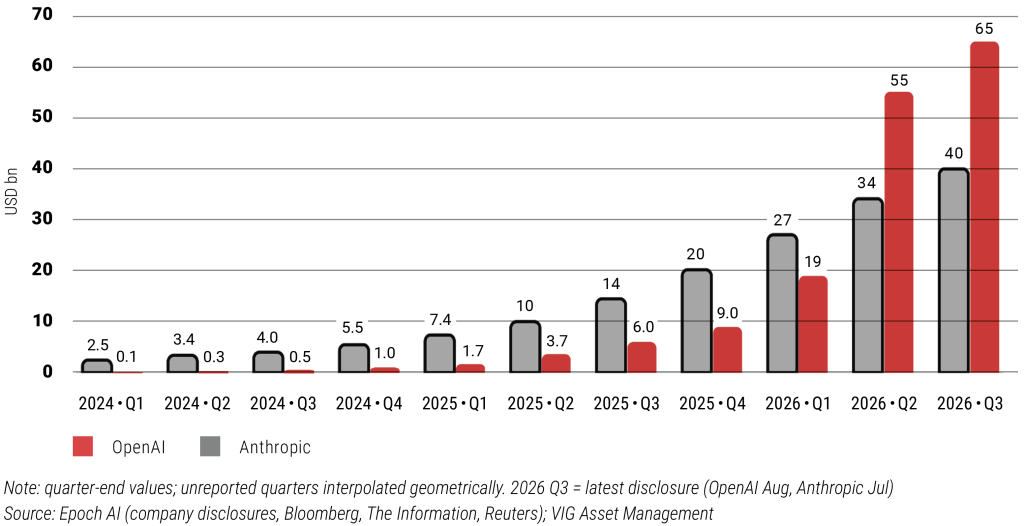
According to September reports, the company could raise as much as $100 billion at a valuation of roughly $2 trillion, while its annual revenue has climbed above $65 billion from about $9 billion at the end of 2025 and could reach $100 billion by the end of 2026. As a result of the share offering, Elon Musk’s flagship SpaceX could lose its title as the largest public offering of all time after just a few months. Nvidia, incidentally, would also join the transaction with as much as $10 billion, in keeping with the circular IT-sector financing that has become a tradition in recent years.
How does an AI lab actually work?
Research, training, inference
The operating model of an “AI lab” is relatively simple. It has access to a certain amount of compute capacity, which it rents from hyperscalers and from new-generation cloud providers built for the age of artificial intelligence (AI), known as neoclouds, but increasingly it also uses its own data centers. Put simply, it spends that capacity on three things:
- Research: searching for new methods and capabilities.
- Training: creating new models.
- Inference (running models): using existing models.
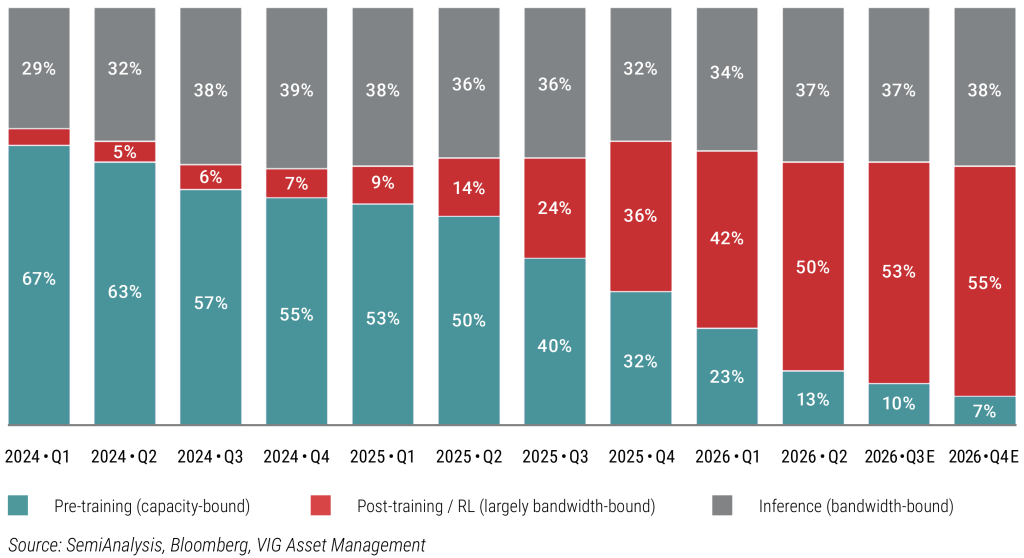
Of these, only the last generates money, since users are only willing to pay for running existing models. The other two are needed so that there is something to run next year as well. Each workload is constrained by a different resource: in some cases speed, in others memory bandwidth, or fast chip-to-chip communication is the bottleneck. This has many consequences for investors, opening up room for custom chips and chip architectures.
Breakdown of Anthropic and OpenAI combined compute capacity by use, %
Research or make money?
The labs’ biggest dilemma is how much capacity to allocate to what. If too much goes to research, money runs out very quickly, so they also have to run the models to keep the company’s cash flow from getting too bad. But if they run too much, a rival that does more research may overtake them with its next model and take their market. If they had their way, the labs would do research exclusively towards artificial superintelligence, so they only reluctantly allocate capacity to letting users generate dashboards and Ghibli images in one of the world’s best-known animation styles. As Anthropic becomes a public company, it will come under pressure to generate as much money as possible as soon as possible, and it will resist this to the best of its ability. This contradiction could soon come to the fore at the company.
Why go public, then?
The appetite for compute cannot shrink
- Ever larger models. The basic idea of AI rests on the premise that the bigger the model and the more data we train it on for longer, the smarter it becomes. Today’s frontier models have roughly a few trillion parameters, orders of magnitude larger than those of a year or two ago, and orders of magnitude smaller than the models that will be running two years from now. Bigger model, more memory, more storage, more compute. And more economic value too, because the model is smarter and can do more things.
- More compute during inference. The labs have also discovered that the longer we let AI think, the better it does its job, much like humans. This means that compute demand could explode not only on the training side but on the inference side as well.
- Compute-intensive research. Often thousands of agents work non-stop for days on a problem at the same time, which can cost many millions of dollars and valuable capacity. According to OpenAI’s September 6, 2026 post, its research division already uses more than three agent-workdays for every human workday, and has reached the goal it set the previous autumn: the “automated research intern”. According to the post, the most active OpenAI researchers spend more than $7,000 a day on tokens.
With capital needs of this size, it is understandable that Anthropic wants to raise as much capital as possible. By its own account, the company is already profitable “on an adjusted basis”, although the adjustments rather generously remove some of the fundamental costs of creating the models from the equation. That does make things easier. But even this profit is not enough to finance the planned expansion: the development of the next model and the capacity for future users must be paid for in advance, while in this fierce competition even a single missed year could be fatal.
The entire AI trade faces a test
The offering documentation could make exciting reading even for those who have no intention of buying Anthropic shares. From chipmakers to power producers, the entire AI trade is built on the premise that someone at the end of the chain will pay enough for intelligence for the massive investment to pay off.
Even losses in themselves would not be a problem. It makes a huge difference, however, whether the money is being consumed by research on the next model, or whether serving existing customers is uneconomical. With strong margins and steadily growing customer spending, the market would receive fresh confirmation that it is worth continuing to build. If, however, the funding gap simply grows along with revenue, suppliers’ growth expectations could also be called into question.
Opening the black box could thus be the next big catalyst for the entire AI trade. Good numbers could give the story fresh momentum; bad ones could start deflating the AI bubble far more broadly than just at Anthropic.
Return Download
This is a marketing communication. Making a well-informed investment decision requires obtaining detailed information. Please read the Key Information Document, the official prospectus, and the management regulations available at the distribution points of the Fund and on the website of the Fund Manager (www.vigam.hu) for detailed information regarding the Fund’s investment policy, distribution costs, and the possible risks of investing. Costs related to the distribution of the investment fund (purchase, holding, sale) can be found in the Fund’s management regulations and at the distribution points. Past performance is not a reliable indicator of future returns. Future returns from the investment may be subject to taxation, and tax and duty information relating to individual financial instruments and transactions can only be accurately assessed based on the individual circumstances of each investor, which may change in the future. It is the investor’s responsibility to obtain information regarding tax obligations.
The data contained in this information material are provided for informational purposes only and do not constitute investment advice, an offer, or investment consulting. VIG Investment Fund Management Hungary Ltd. accepts no liability for investment decisions made based on this information or for their consequences. The license number of the Fund Manager for alternative investment fund management (AIFM) is: H-EN-III-6/2015. The license number of the Fund Manager for UCITS fund management (collective portfolio management) is: H-EN-III-101/2016.