The Beijing Robot Olympics: spectacle vs. economic impact
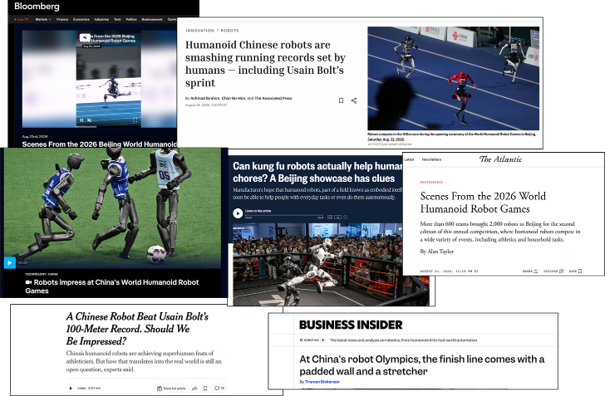
Watching the videos of Chinese robots circulating online, it is increasingly hard to tell whether we are looking at real footage or yet another particularly well-made creation of artificial intelligence. Today, humanoid machines move with such momentum and naturalness that just a few years ago we would have instantly taken these scenes for clips from a sci-fi film. The humanoid robot competition in Beijing, however, showed in front of a live audience just how far the technology has come.
source: Citrini Research
At the World Humanoid Robot Games held in August 2026, more than two thousand robots competed in a total of 51 event categories, covering everything from sports tasks to contests simulating industrial work. One of the biggest attractions was the Tiangong Ultra robot, which crossed the finish line in the 100-meter final in 8.64 seconds, faster than Usain Bolt’s human world record of 9.58 seconds.
It is increasingly said that robotics is waiting for its own ChatGPT moment. In robotics, however, technological progress, public recognition and economically viable application may arrive at different times. An image of a humanoid running on an athletics track can go viral in moments without meaningfully changing how a factory operates, while a less spectacular development that significantly simplifies robot training could have a much greater economic impact over time.
Less training, more tasks
Generalist: a few seconds of demonstration
Particularly interesting is Generalist’s GEN-1.5 model, unveiled on August 19. In the company’s experiments, it can perform new, short object-manipulation tasks based on a demonstration of just 3 to 12 seconds, without any separate fine-tuning of the model. The demonstrations typically contained both sensory and motion data, so the result should not be imagined as a robot learning anything by watching an arbitrary internet video: the developers, too, showcased the capability on simple, short tasks.
Its significance, however, may extend far beyond these rudimentary tasks. One of the major costs of robotization is the development and deployment work required to make a machine usable in a given environment. If previously acquired experience can be transferred to other workflows with just a few new examples, then automating small-batch or frequently changing activities, for which lengthy programming has so far been too expensive, could also pay off. Unzipping a zipper may seem a modest achievement in itself, but a radical reduction in the training needed to master it could be the harbinger of a much more general change.
Figure: with a full humanoid body
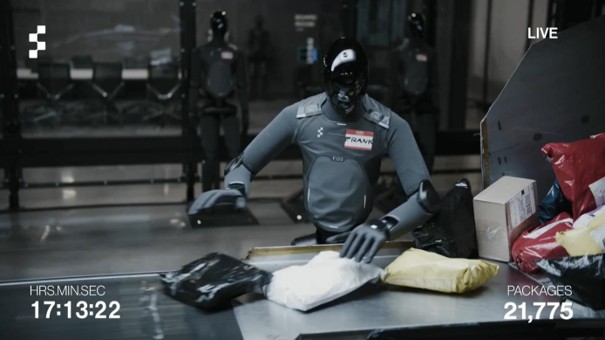
Figure Inc., another US humanoid robotics heavyweight founded in 2022, approaches the same problem with a fully human-shaped body, which is no simple task, since while grasping objects the robot must also continuously coordinate its locomotion and balance. According to the company, the Helix 02, unveiled in January 2026, navigated a kitchen in a four-minute, fully autonomous sequence of tasks, carrying dishes from one place to another and then unloading and loading the dishwasher. For a human these are naturally connected movements, but the robot has to adapt at every step to the fact that the object in its hands and its body posture change the conditions of movement. More tangible results have already been achieved in more structured industrial settings, where the reliable execution of a narrower task can create value. According to Figure, the Figure 02 operating at BMW’s Spartanburg plant moved more than 90,000 sheet-metal parts over more than 1,250 operating hours, contributing to the production of more than 30,000 cars.
source: Techradar
Boston Dynamics: heading for the factory
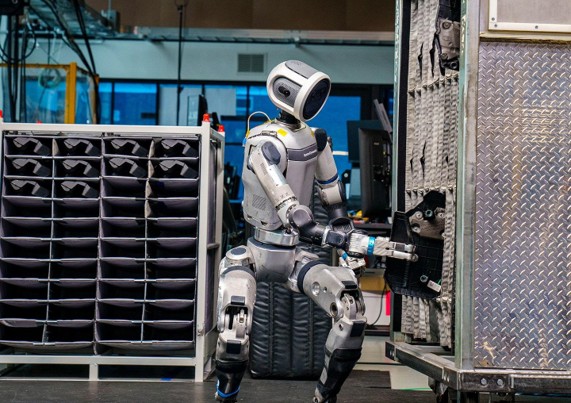
Famous for its exceptionally agile robots capable of dynamic balancing and for the viral internet videos of them, and originally launched as a Massachusetts Institute of Technology (MIT) spin-off, Boston Dynamics is likewise placing increasing emphasis on production-grade work, which requires not only impressive movement but also integration with factory systems and reduced downtime. In January the company unveiled the product version of the electric Atlas and announced planned deployments at Hyundai and Google DeepMind for 2026, while also working with DeepMind on integrating foundation models. Autonomous battery swapping and connectivity to factory IT systems are already aimed at enabling the robot to be integrated into production on a lasting basis, although a distinction must still be made between announced capabilities and operation proven at high volume.
Source: The Verge
Does it need a human shape?
Beyond all this, it remains an open question how large a role humanoid machines will play in the next wave of robotics. The strongest argument for the humanoid form is that we designed our environment for humans, so a robot of similar size and range of motion could in principle use the same workbenches, shelves and tools without having to rebuild the entire workplace around it. This could be especially valuable where the machine has to switch between multiple workflows or move around areas originally designed for human movement.
Imitating the human body, however, comes with a complexity that many applications do not need: on a flat floor, for example, a wheeled platform may suffice, and at a fixed workstation a stationary robotic arm. The progress of AI applicable in the physical world could therefore affect a much broader market than one might first imagine based on the viral humanoid videos.
Where does the ChatGPT analogy fall short?
The limits of the ChatGPT analogy become truly visible when attention shifts from capabilities to adoption. An internet service can be tried by the masses in a short time, whereas every new robot put to work requires a physical machine to be manufactured and delivered. Software improvements can quickly reach devices already in operation, but the growth of the installed base is also determined by manufacturing, deployment and the build-out of maintenance support. As a result, even a highly convincing technological breakthrough would not automatically lead to the immediate, mass appearance of robots.
The most important yardstick of progress will therefore be how many kinds of tasks the machines can perform, how often they need human assistance, and how much the work they successfully complete costs. As these metrics improve, robots that still seem futuristic today could gradually become part of the everyday economy, whether or not there is a single, clearly identifiable ChatGPT moment.
Return Download
This is a marketing communication. Making a well-informed investment decision requires obtaining detailed information. Please read the Key Information Document, the official prospectus, and the management regulations available at the distribution points of the Fund and on the website of the Fund Manager (www.vigam.hu) for detailed information regarding the Fund’s investment policy, distribution costs, and the possible risks of investing. Costs related to the distribution of the investment fund (purchase, holding, sale) can be found in the Fund’s management regulations and at the distribution points. Past performance is not a reliable indicator of future returns. Future returns from the investment may be subject to taxation, and tax and duty information relating to individual financial instruments and transactions can only be accurately assessed based on the individual circumstances of each investor, which may change in the future. It is the investor’s responsibility to obtain information regarding tax obligations.
The data contained in this information material are provided for informational purposes only and do not constitute investment advice, an offer, or investment consulting. VIG Investment Fund Management Hungary Ltd. accepts no liability for investment decisions made based on this information or for their consequences. The license number of the Fund Manager for alternative investment fund management (AIFM) is: H-EN-III-6/2015. The license number of the Fund Manager for UCITS fund management (collective portfolio management) is: H-EN-III-101/2016.