The reality of space data centers
Elon Musk’s SpaceX, now publicly traded, has made the following ultimate promise: we will take AI into space. SpaceX is the only company that has everything it takes to do this. The xAI division, which recently merged with the company, provides the AI component; the previously established Starlink division handles the satellites; and the division that originally operated under the name SpaceX is a leader in space rockets and spacecraft.
However, it’s worth examining whether, while building orbital data centers is possible, it is actually a rational decision. Below, we’ve compiled a few misconceptions that are often cited as arguments in favor of orbital data centers but do not hold up in reality. Our aim is to shed light on the challenges of deploying chips in space.
“24 hours of solar power a day”
A satellite orbiting in low Earth orbit receives sunlight for only about 60% of the time, so expensive battery-based energy storage would be required for the remainder of the time. The so-called sun-synchronous orbit, which remains in sunlight almost continuously, is indeed viable, but it offers too little capacity for the large-scale deployment of data centers in space.
“Cooling is free, since space is cold”
One of the most significant limiting factors for terrestrial data centers is cooling. AI chips generate a tremendous amount of heat, and dissipating that heat is extremely difficult and resource-intensive. Of all the factors limiting the size of current data centers, this is perhaps the most serious. However, solving the problem of cooling in space is an even greater challenge: in a vacuum, there is no convection, only radiative heat transfer. The International Space Station is the most expensive object ever built by humankind, and its radiators dissipate only 70 kW of heat over 325 m², at a cost of $340–500 million. This is a fraction of the cooling capacity that even a single small data center would require.
“The limit to Earth’s computing capacity lies with data centers, which is why we need orbital capacity”
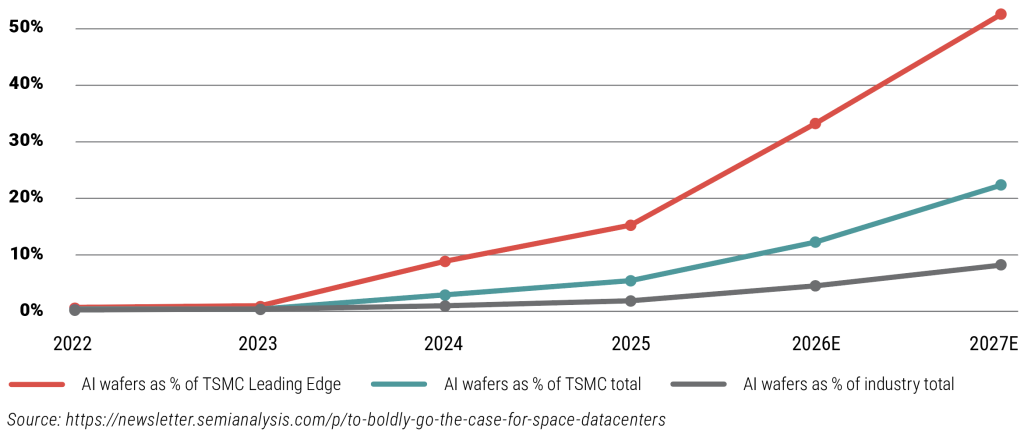
According to industry experts, the bottleneck in the coming years will not be Earth-based data center capacity, but rather the production of chips sufficient to power these centers. The manufacturing of both AI chips and more advanced memory chips is more lithography-intensive than previous generations. This means that fierce competition will arise for the capacity of major chip manufacturers (TSMC, Intel, and, in the future, Terafab). In the absence of significant capacity expansions, the production of AI chips could crowd out demand for the manufacturing of products such as phones, personal computers, and other consumer electronics. This phenomenon can already be observed today in the market for RAM for personal computers, where prices have more than doubled across the board in recent months.
AI wafers as % of foundry capacity
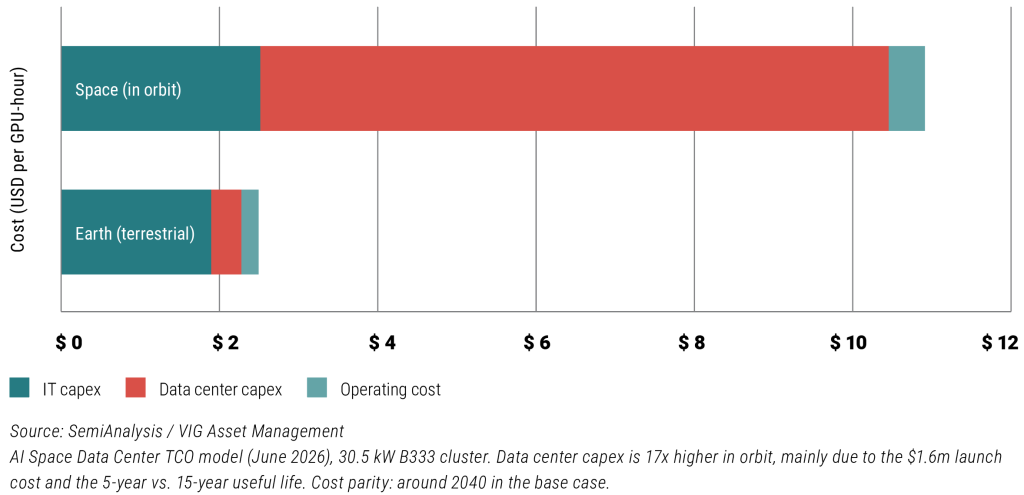
According to analyses, deploying a 30-kW cluster (16 GPUs) in space, using current technology, costs roughly $4.1 million, compared to $1.4 million on Earth. The IT hardware itself is essentially the same, costing roughly $1 million in both cases. The entire difference lies in the data center layer, which costs $3.1 million in space compared to just $382,000 on Earth, an eightfold difference. Added to this is the cost of a single launch, approximately $1.6 million. This is based on the current cost level of the Falcon 9 rocket ($1,400–$1,800/kg), which SpaceX aims to reduce to $250/kg with its “Starship” spacecraft.
The difference grows even further on a per-unit basis, as the assumed lifespan of space hardware is only 5 years compared to 15 years on Earth, which increases the per-unit facility cost by a factor of 17–18. Even setting that aside, the total cost of ownership is $8.64 versus $2.37 per GPU-hour.
The bottom line: orbital data centers currently entail a cost burden many times greater than their terrestrial counterparts, primarily due to launch costs and the short hardware lifespan.
Estimated compute cost: space vs. Earth, 2026
 Return
Download
Return
Download
This is a marketing communication. Making a well-informed investment decision requires obtaining detailed information. Please read the Key Information Document, the official prospectus, and the management regulations available at the distribution points of the Fund and on the website of the Fund Manager (www.vigam.hu) for detailed information regarding the Fund’s investment policy, distribution costs, and the possible risks of investing. Costs related to the distribution of the investment fund (purchase, holding, sale) can be found in the Fund’s management regulations and at the distribution points. Past performance is not a reliable indicator of future returns. Future returns from the investment may be subject to taxation, and tax and duty information relating to individual financial instruments and transactions can only be accurately assessed based on the individual circumstances of each investor, which may change in the future. It is the investor’s responsibility to obtain information regarding tax obligations.
The data contained in this information material are provided for informational purposes only and do not constitute investment advice, an offer, or investment consulting. VIG Investment Fund Management Hungary Ltd. accepts no liability for investment decisions made based on this information or for their consequences. The license number of the Fund Manager for alternative investment fund management (AIFM) is: H-EN-III-6/2015. The license number of the Fund Manager for UCITS fund management (collective portfolio management) is: H-EN-III-101/2016.