Nvidia has fallen behind
For a long time the clear winner of the AI trade that took flight after the 2022 bear market was Nvidia, the American maker of high-performance processors. The company’s share price rose almost seventeenfold from its low of $11.2 in the autumn of 2022 to the end of 2025. Anyone looking only at the returns of the past year, however, sees a laggard: the stock gained just 18% against a rise of more than 100% in the broader chip sector. There are several reasons for this. One is simple size mathematics: a market capitalisation of nearly $5 trillion in itself limits how much growth can realistically be expected from the world’s most valuable company. There are, however, a few more interesting factors that may raise genuine doubts about Nvidia’s market position and long-term return potential.
Custom hyperscaler chips
The technology giants competing in the AI race are all working on chips of their own. Nvidia’s chips are very good general-purpose tools for AI computation, but there are specialised computing tasks where performance can be improved further. In order to avoid the extremely high profit margin on Nvidia’s products, Google, Amazon, Microsoft, Meta and OpenAI have all created their own chip. These are typically more powerful or more economical than Nvidia’s chips in some narrow field of application, and they reduce companies’ dependence on the chip giant’s monopoly. The value chain of ASIC (Application Specific Integrated Circuit) chips bypasses Nvidia. Tech companies design these chips jointly with the American firms Marvell and Broadcom, leaders in the manufacturing of custom artificial intelligence chips and high-speed networking equipment, while 95% of production is handled by Taiwan’s TSMC. It is important to note, however, that their use is for now almost entirely confined to internal purposes, and they only represent a threat to the medium- and long-term growth of Nvidia’s addressable market rather than to its current market position.
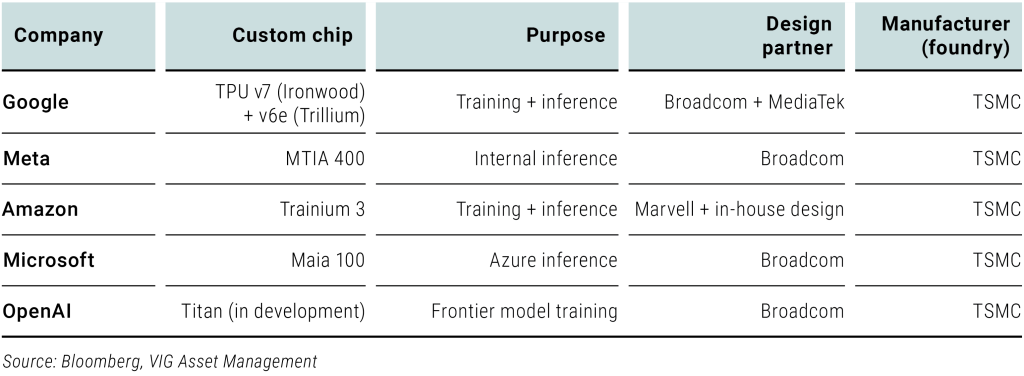
One of the leading AI labs, Anthropic, has access to more than one million Google TPUs, and there are models it trains and runs primarily on TPUs. (The TPU is Google’s own application-specific chip, designed expressly to accelerate machine learning and matrix mathematics workloads.) This supports the view that Nvidia is not indispensable in the AI chip market.
Training vs. inference
When we talk about AI data centres, they generally do two main things:
- Training is the process in which artificial intelligence models learn patterns from vast data sets (text, images or video) and build up the linguistic or visual knowledge they need in order to function. This involves moving, reading and writing enormous quantities of data, and it is a continuous task lasting weeks or even months. Besides raw computing power, the decisive bottleneck is how well the chips can communicate with one another. A frontier model does not fit on a single chip; it is typically distributed across more than ten thousand accelerators (these are specialized hardware devices designed to perform AI computations much faster than conventional processors), which have to synchronise with each other at every training step. Chip-to-chip communication is the area where Nvidia is strongest, which is why it is expected to remain dominant in model training over the long term.
- Inference, by contrast, is the running of the finished model. A question comes in and an answer goes out. Inference has a compute-intensive phase, when the model reads and processes the question, and a memory-intensive phase, when it generates the answer token by token. The latter depends not only on computing power but also on memory bandwidth. To produce every new token, the chip has to read the model’s activated weights from memory. So however much raw compute capacity sits on the chip, if it cannot load the weights fast enough the arithmetic units will be “bored”. The inference phase requires far less that ten thousand chips to operate, as it only needs to operate a single coherent machine. Memory bandwidth, energy and cost efficiency per unit of performance under a given response-time constraint matter far more.
The centre of gravity of AI compute has been shifting from training towards inference for years, especially thanks to agentic models and models that reason through logical steps. Agentic artificial intelligence is a program that is able to pursue goals, use software or other tools, and carry out operations with a certain degree of autonomy. Today inference accounts for roughly two-thirds of compute, and this is the workload where the hyperscalers’ own chips (these are the giant tech companies that build and operate digital infrastructure on an enormous scale: millions of servers in hundreds of data centres) can compete more easily with Nvidia’s ecosystem. The further we move towards the world of inference, the less Nvidia will be the only possible answer.
Return Download
This is a marketing communication. Making a well-informed investment decision requires obtaining detailed information. Please read the Key Information Document, the official prospectus, and the management regulations available at the distribution points of the Fund and on the website of the Fund Manager (www.vigam.hu) for detailed information regarding the Fund’s investment policy, distribution costs, and the possible risks of investing. Costs related to the distribution of the investment fund (purchase, holding, sale) can be found in the Fund’s management regulations and at the distribution points. Past performance is not a reliable indicator of future returns. Future returns from the investment may be subject to taxation, and tax and duty information relating to individual financial instruments and transactions can only be accurately assessed based on the individual circumstances of each investor, which may change in the future. It is the investor’s responsibility to obtain information regarding tax obligations.
The data contained in this information material are provided for informational purposes only and do not constitute investment advice, an offer, or investment consulting. VIG Investment Fund Management Hungary Ltd. accepts no liability for investment decisions made based on this information or for their consequences. The license number of the Fund Manager for alternative investment fund management (AIFM) is: H-EN-III-6/2015. The license number of the Fund Manager for UCITS fund management (collective portfolio management) is: H-EN-III-101/2016.