Number of the month: six years, or how long does a GPU last?
That is the length to which almost every major “hyperscaler” (i.e. technology giants attracting enormous amounts of capital, such as Microsoft or Amazon) has extended the useful book life of its servers and GPUs in recent years, up from the previously typical four years. Stretching an asset’s depreciation period means lower annual depreciation and thus higher profit, so it is no surprise that many consider the move an accounting trick. The loudest of the critics is Michael Burry, the investor who became famous for shorting the 2008 subprime mortgage crisis. According to his estimate last November, between 2026 and 2028 these giants will collectively understate depreciation by roughly $176 billion, thereby artificially inflating their earnings. The argument is logical: if AI chips become obsolete with a new generation every year, then a six-year depreciation period is an optimistic fiction.
Secondary market prices, however, tell a different story.
At market prices: what GPUs are really worth
Residual values as a percentage of purchase price, by years since mass availablity
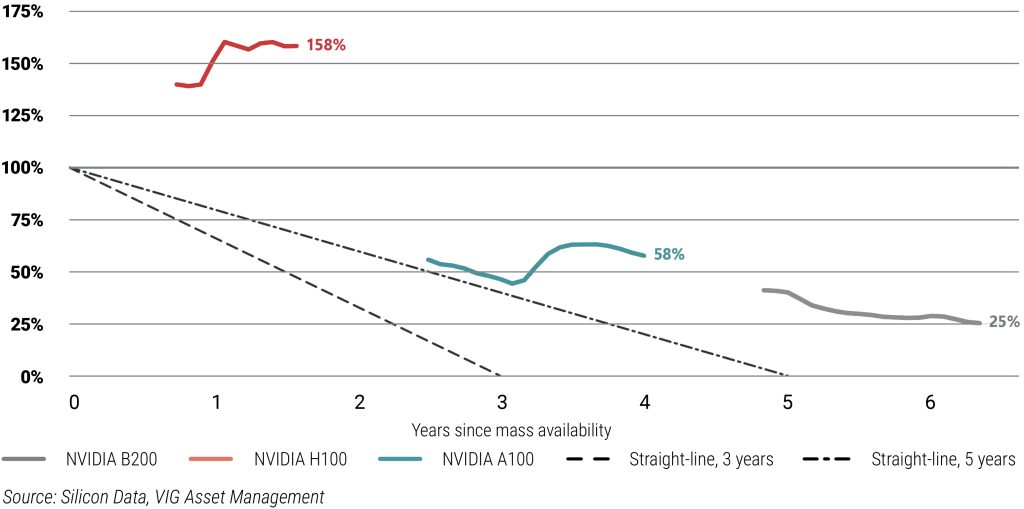
According to Silicon Data, the market value of GPUs sits well above the linear depreciation path. The Nvidia H100, which became widely available four years ago, is still worth 58 percent of its purchase price today, while under five-year straight-line depreciation it would be carried on the books at just 20 percent. Another processor, the A100, is still worth a quarter of its purchase price after more than six years, while the newest B200 already fetches more than one and a half times its purchase price due to tight supply.
Extending useful lives is more about tracking economic reality than cosmetically dressing up the numbers. An older chip remains useful even after it is retired from training cutting-edge (“frontier”) models: it can be put to good use for running models (inference), for smaller models or for less demanding tasks. And as long as someone is willing to pay for it, it has value. Compute capacity is thus increasingly behaving like a genuine, priceable asset class, with its own rental and secondary markets. Based on current data, the framing that extended amortization is merely a dubious tool for presenting better numbers does not hold up.
Return Download
This is a marketing communication. Making a well-informed investment decision requires obtaining detailed information. Please read the Key Information Document, the official prospectus, and the management regulations available at the distribution points of the Fund and on the website of the Fund Manager (www.vigam.hu) for detailed information regarding the Fund’s investment policy, distribution costs, and the possible risks of investing. Costs related to the distribution of the investment fund (purchase, holding, sale) can be found in the Fund’s management regulations and at the distribution points. Past performance is not a reliable indicator of future returns. Future returns from the investment may be subject to taxation, and tax and duty information relating to individual financial instruments and transactions can only be accurately assessed based on the individual circumstances of each investor, which may change in the future. It is the investor’s responsibility to obtain information regarding tax obligations.
The data contained in this information material are provided for informational purposes only and do not constitute investment advice, an offer, or investment consulting. VIG Investment Fund Management Hungary Ltd. accepts no liability for investment decisions made based on this information or for their consequences. The license number of the Fund Manager for alternative investment fund management (AIFM) is: H-EN-III-6/2015. The license number of the Fund Manager for UCITS fund management (collective portfolio management) is: H-EN-III-101/2016.