Megatrend newsletter – What we wrote to our investors in August
In the megatrend universe, market movements in August were favorable for the Fund. Rebounding from the July low, global equity markets started the month with a strong two-week rally. Later in the month, the impact of the macroeconomic news flow on equity indices intensified, which weighed on performance in the second half of the month.
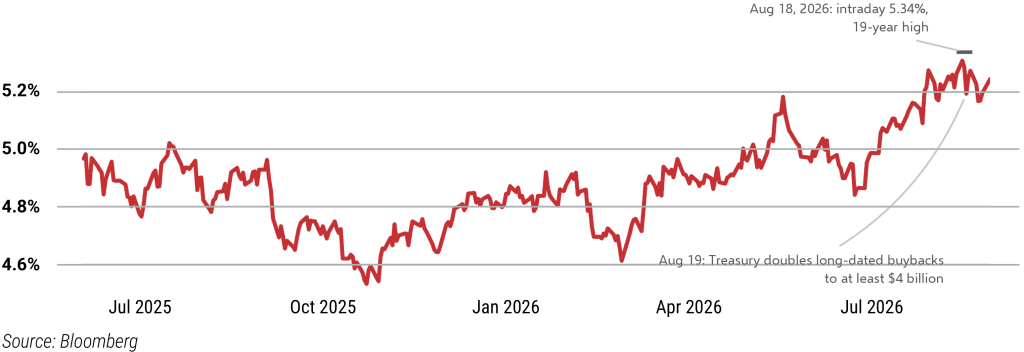
The month’s most important narrative was the bond market. The US 30-year yield rose above 5.33% on August 18, a 19-year high. In response, Scott Bessent, head of the Treasury, “at least” doubled the long-dated bond buyback program, from $2 billion to at least $4 billion. However, this brought only short-term relief to the market. It was also floated that Bessent could deploy the Treasury’s nearly $1 trillion General Account to fund the buybacks. All of this is news that undermines the dollar’s strength, from which gold benefited: the December gold futures contract rose to $4,570 after five consecutive weeks of gains.
The bond market was the month’s main narrative
US 30 -year Treasury yield, daily closes
Due to a combination of forced liquidation linked to the collapse of the Aschenbrenner leveraged fund and fears of price pressure from the Chinese memory industry, the chip sector index fell 21% in July, setting a negative record not seen in more than 20 years. The August rebound was clearly visible, but at the end of the month the best performers of the first half were still well below their previous peaks. On August 26, Nvidia’s earnings report beat expectations, and the stock rose nearly 9% on the following trading day. The company raised its 2027 revenue growth expectations by more than 25 percentage points, which, given NVDA’s size, is a positive development of macroeconomic significance for the outlook of the AI trade. In terms of year-to-date return, the stock had been among the laggards, especially compared with other names in the semiconductor sector. Unusually, however, chipmakers’ share prices did not rise together in the days following the report: NVDA regained its leading position, while the stocks that had previously displaced it failed to rise alongside it.
Fed Chair Kevin Warsh struck a much more hawkish tone in his Jackson Hole speech on the 28th than at the July press conference. He committed to the 2% PCE inflation target and did not describe the monetary environment as broadly restrictive. The priced-in probability of a September rate hike nearly doubled in the days following the speech.
Market rotations also painted an interesting picture in August. The Magnificent 7 fell to a record-low valuation in early August. The hyperscalers play a financing role in the build-out of AI infrastructure, which the market punishes with low valuations and lagging returns. Pressure on the software sector, one of the strongest narratives of the first half of the year, eased further. Companies in the sector have so far successfully resisted AI disruption and have rebounded strongly over the past two months, in parallel with the correction in the semiconductor trade.
Taking advantage of the sharp correction, at the beginning of the month we built a larger position in the Fund in the Korean market, which shows strong growth and solid fundamentals. Given the concentration of the country’s market, this is primarily a position that increases the weight of the chip sector.
Return Download
This is a marketing communication. Making a well-informed investment decision requires obtaining detailed information. Please read the Key Information Document, the official prospectus, and the management regulations available at the distribution points of the Fund and on the website of the Fund Manager (www.vigam.hu) for detailed information regarding the Fund’s investment policy, distribution costs, and the possible risks of investing. Costs related to the distribution of the investment fund (purchase, holding, sale) can be found in the Fund’s management regulations and at the distribution points. Past performance is not a reliable indicator of future returns. Future returns from the investment may be subject to taxation, and tax and duty information relating to individual financial instruments and transactions can only be accurately assessed based on the individual circumstances of each investor, which may change in the future. It is the investor’s responsibility to obtain information regarding tax obligations.
The data contained in this information material are provided for informational purposes only and do not constitute investment advice, an offer, or investment consulting. VIG Investment Fund Management Hungary Ltd. accepts no liability for investment decisions made based on this information or for their consequences. The license number of the Fund Manager for alternative investment fund management (AIFM) is: H-EN-III-6/2015. The license number of the Fund Manager for UCITS fund management (collective portfolio management) is: H-EN-III-101/2016.