Commodities outlook 2026

In our base-case scenario, most of the global disinflation process is already behind us, and improving growth prospects are set to support commodity demand in 2026.
Under these conditions, a broad-based increase in commodity prices appears likely. In our optimistic scenario, AI-driven productivity gains help keep inflation and energy prices contained, limiting commodity price appreciation with a few key exceptions. Conversely, our pessimistic scenario points to weaker commodity markets, as rising interest rates could push the global economy toward recession, reducing overall demand.
Based on our analysis, three commodity segments stand out in 2026 with the potential for meaningful upside: gold, copper, and agricultural products.
Gold
Gold delivered a spectacular rally of more than 50% in 2025, driven by geopolitical uncertainty, concerns over the sustainability of the U.S. fiscal path, a dovish Federal Reserve, and record levels of central bank buying. The Trump administration’s unpredictable economic policy decisions and explicit preference for a weaker U.S. dollar reinforced this “unorthodox policy mix,” historically known to support gold—similar to previous bull markets anchored in the oil crisis, stagflation, quantitative easing, or the COVID-19 shock.
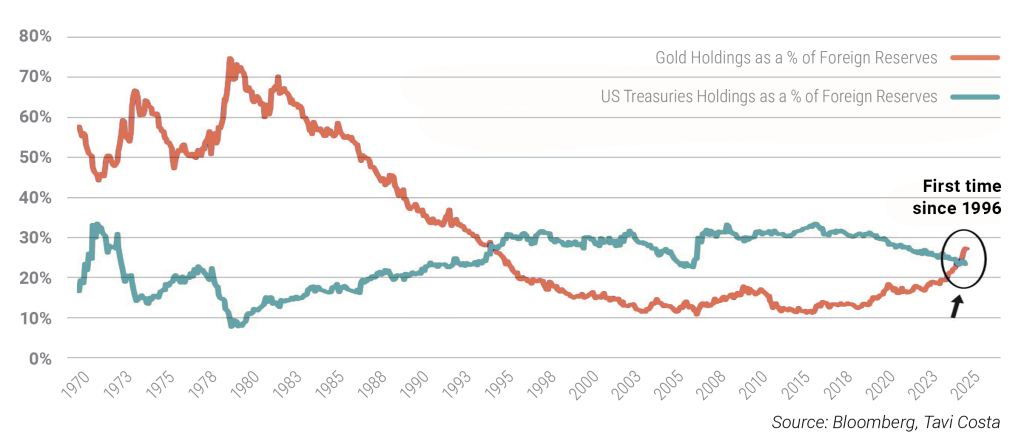
Central-bank reserve diversification is adding a structural tailwind: for the first time in thirty years, foreign central banks now hold more gold than U.S. Treasuries. Meanwhile, retail and institutional portfolios remain underweight in gold, partly due to the post-COVID rise in stock–bond correlations—meaning the asset class is still broadly underowned.
Following the exceptional 2025 rally, the autumn correction was natural and in line with previous bull-market patterns, where sharp pullbacks typically preceded renewed gains. Entering 2026, the fundamental drivers remain in place: elevated global debt levels, a weaker-USD policy stance, deteriorating fiscal outlooks, and a likely Fed rate-cutting cycle. Historically, gold performs particularly well when the Federal Reserve eases policy while inflation remains above 2%.
Overall, while a repeat of the 2025 surge appears unlikely, the macro backdrop continues to suggest meaningful upside potential for gold in 2026.
Foreign central banks hold more gold than treasuries
Copper
Copper is poised to be one of the most interesting commodities in 2026. The rapid expansion of artificial intelligence is triggering an unprecedented wave of data-center construction, placing enormous pressure on global electricity grids. Major economies are not yet prepared for this surge in demand, making large-scale upgrades and modernization of power infrastructure inevitable.
A historical parallel can be drawn to the post-World War II United States: while the electric grid managed the introduction of household appliances in the late 1940s, it collapsed under the widespread adoption of air conditioning in the early 1950s, forcing the country into a decade of grid expansion. The AI revolution may create a similar dynamic today—resulting in a highly supportive demand environment for copper.
Agricultural Products
Agricultural commodities may also present attractive opportunities in 2026. In 2025, China effectively halted purchases of U.S. agricultural goods, severely impacting American farmers and driving many into bankruptcy. As 2026 is an election year in the United States, the Trump administration is expected to make significant efforts to secure Republican control of both chambers of Congress. This places particular political emphasis on agricultural states, where restoring Chinese demand for U.S. soybeans, corn and wheat may be crucial.
If U.S.–China trade in agricultural goods resumes, it could trigger substantial price increases—creating favourable return prospects for investors in this segment.
További cikkekBefektetési Kilátások 2026 Dokumentum megtekintéseLetöltés
Ez egy forgalmazási közlemény. A megalapozott befektetési döntés meghozatalához részletes tájékozódásra van szükség. Az Alap befektetési politikájáról, forgalmazási költségeiről és a befektetés lehetséges kockázatairól részletesen tájékozódjon az Alap forgalmazási helyein és az Alapkezelő weboldalán (www.vigam.hu) található Kiemelt Információkból, hivatalos tájékoztatóból és kezelési szabályzatból. A befektetési alap forgalmazásával (vétel, tartás, eladás) kapcsolatos költségek az alap kezelési szabályzatában és a forgalmazási helyeken megismerhetők. A múltbeli teljesítmény alapján nem jelezhetőek előre a jövőbeli hozamok. A befektetéssel elérhető jövőbeni hozam adóköteles lehet, az egyes pénzügyi eszközökre, ügyletekre vonatkozó adó- és illeték információkat pedig csak az egyes befektetők egyedi körülményei alapján lehet pontosan megítélni, ami a jövőben változhat. A befektető feladata, hogy tájékozódjon az adókötelezettségről. Jelen tájékoztatóban szereplő adatok kizárólag információs célokat szolgálnak és nem minősülnek befektetési ajánlásnak, ajánlattételnek vagy befektetési tanácsadásnak. A VIG Befektetési Alapkezelő Magyarország Zrt. nem vállal felelősséget a jelen tájékoztatás alapján hozott befektetési döntésért és annak következményeiért.
Az Alapkezelő alternatív befektetési alap kezelésére (ABAK) vonatkozó engedélyének száma: H-EN- III-6/2015. Az Alapkezelő ÁÉKBV-alapkezelési (kollektív portfóliókezelési) engedélyének száma: H- EN-III-101/2016.