Central and Eastern European outlook

CEE economies are still waiting for the tide to turn, hoping geopolitical tensions will ease and growth can resume.
CEE GDP Growth
The CEE region remains in a prolonged holding pattern, with economic growth still significantly weaker than in the years before the pandemic and the war. Inflation – though moderating – is materially higher than pre-crisis norms, while fiscal positions have deteriorated sharply as governments absorbed successive shocks. Policymakers, businesses, and investors are acutely aware that the region is operating below potential, effectively waiting for the tide to turn. A lasting return of peace would not only help the dust settle but could also unlock a meaningful improvement across key macroeconomic indicators – from stronger growth and more anchored inflation to a gradual repair of budget balances.
GDP Growth and CPI difference compared to pre COVID/war period (2025/24 avg vs 2019/18 avg)
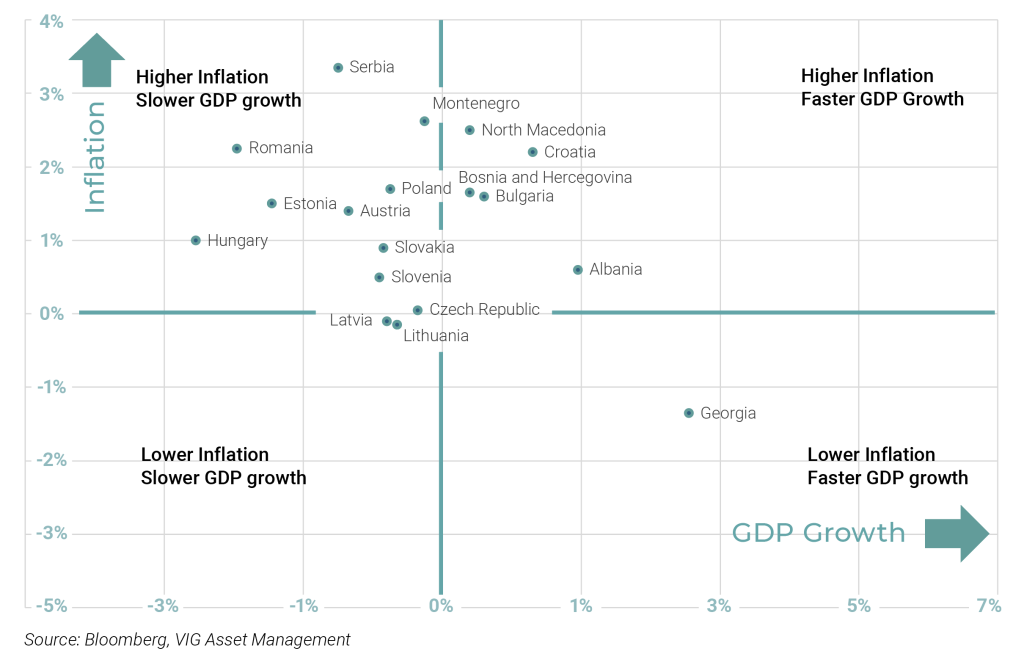
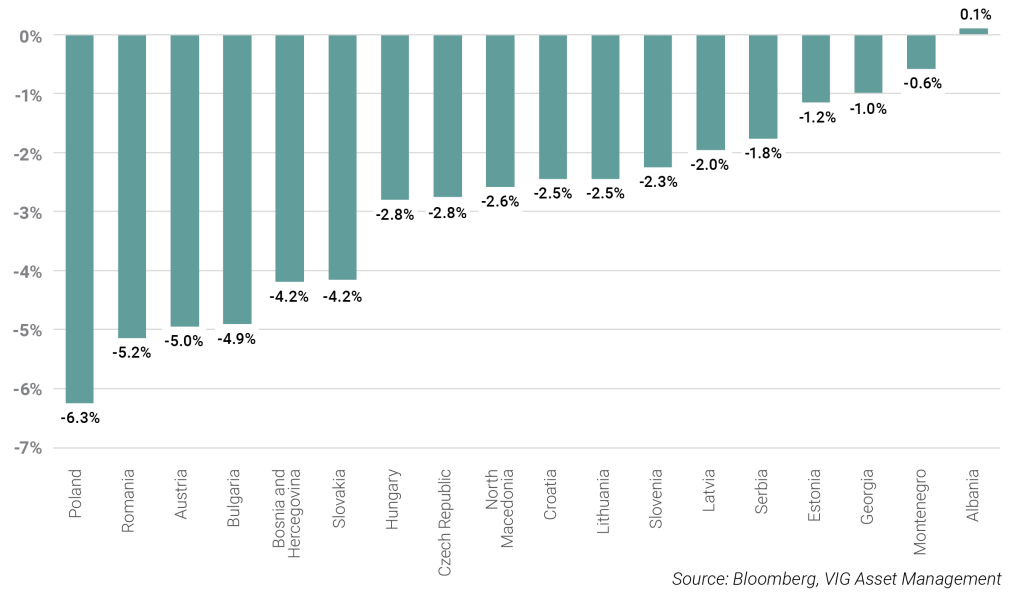
While the CEE countries’ counter-cyclical policy responses helped them exit the COVID-induced recession, they—along with the shockwaves from the Russia–Ukraine war—failed to generate the degree of growth that had been hoped for. At the same time, fiscal deficits remained elevated, weighed down by weaker post-crisis growth dynamics and persistently higher inflation. In many cases, it has also proven difficult for economic policy to step back from the high levels of spending deployed during successive crises. As a result, macroeconomic equilibrium has yet to be restored in most economies, and the additional burden of rising defence expenditures continues to strain public finances.
Fiscal balance deterioration post-crisis vs. pre-crisis (2024-25 avg. vs 2018-19 avg)
CEE government bonds
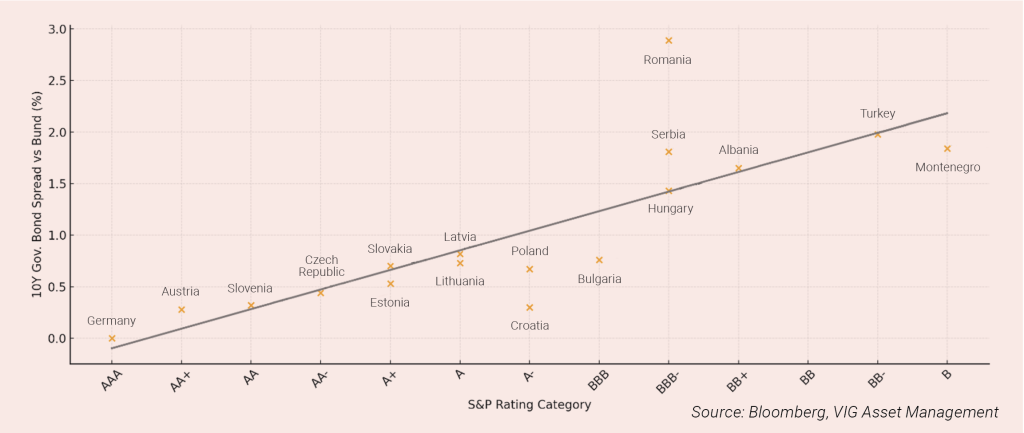
Regional sovereign spreads increasingly reflect the mounting burdens on public finances across several CEE economies. While there remains a broadly linear relationship between credit ratings and 10-year yield differentials, a number of countries stand out meaningfully from the trend. Romania, rated BBB–, trades with a spread of nearly 300 basis points—substantially wider than peers in the same rating bucket—indicating the market’s clear pricing of elevated political and fiscal risks, as well as the possibility of further downgrades; from a yield perspective, however, it offers one of the most notable carry opportunities in the region. Hungary and Serbia, both rated BBB–, also pay a sizeable premium of 140–180 basis points, reflecting a persistent political and fiscal risk premium. In a gradually stabilising macro environment, these spreads could become increasingly attractive for investors willing to take moderate risk.
Sovereign credit rating vs 10Y bond spread (with trendline)
CEE Equities
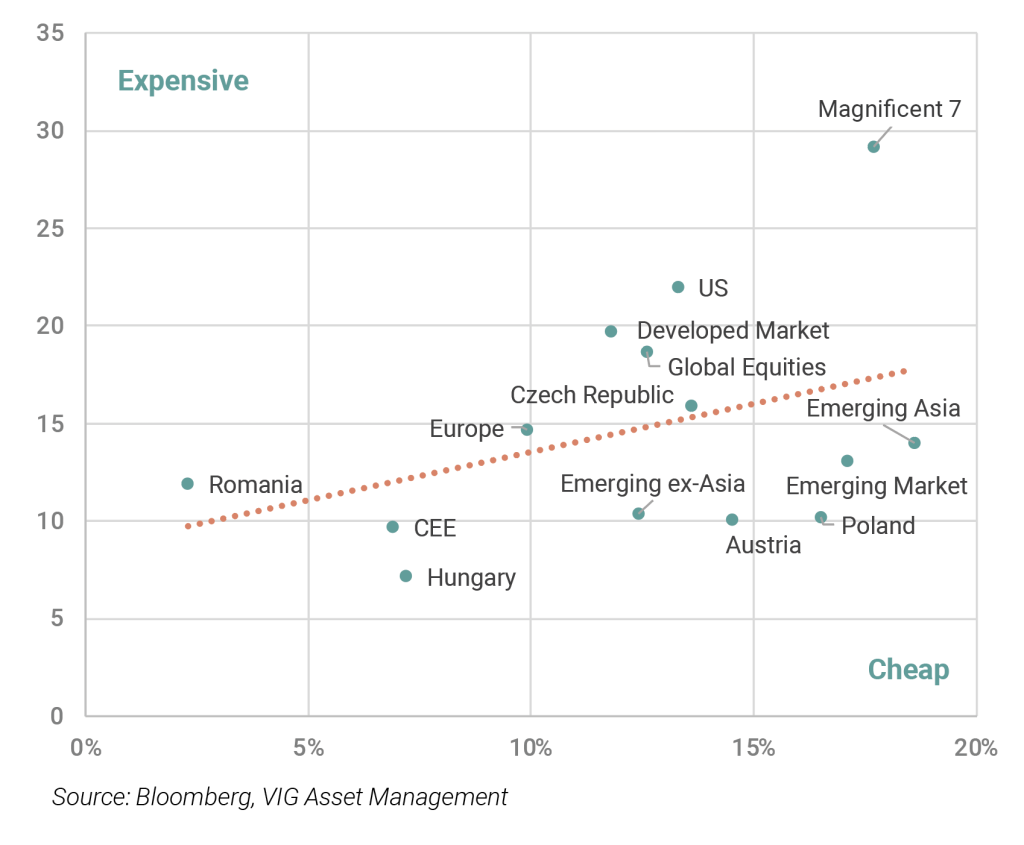
Global equity markets delivered exceptionally strong returns in 2025, and a continuation of this performance increasingly depends on the materialisation of more optimistic macro and earnings scenarios. As Benjamin Graham famously noted, long-term equity performance is driven primarily by dividend income and the trajectory of corporate earnings, though market valuation—such as the price-to-earnings (P/E) ratio of a listed company—also plays a critical role over extended horizons. On a P/E basis, most major equity markets now screen as expensive, with valuations in several regions sitting well above long-term averages, particularly in technology segments linked to artificial intelligence. A notable exception is the CEE equity market, where still single-digit P/E multiples remain below their 10-year norms, offering an attractive entry point. This is reinforced by the fact that earnings prospects for CEE corporates remain broadly favourable, further enhancing the region’s investment appeal.
CETOP index forward P/E 12M
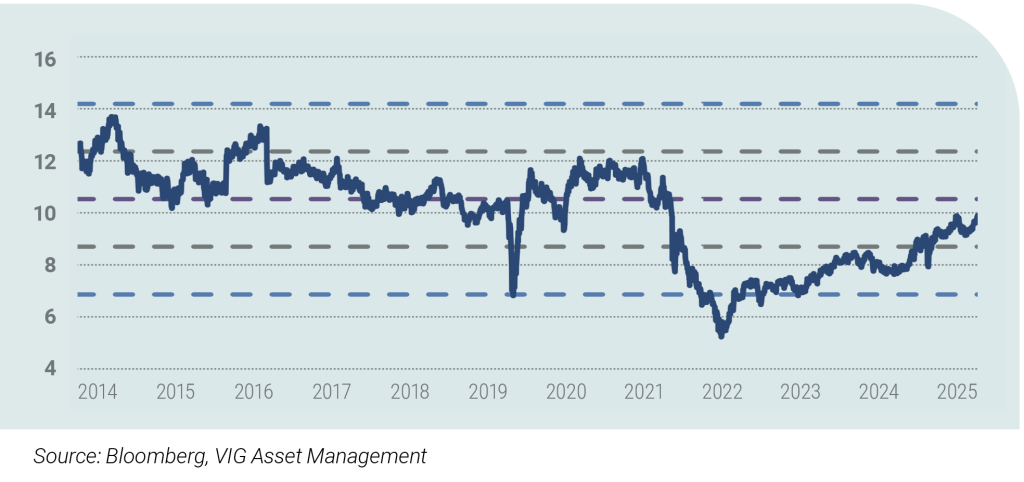
Although CEE equities are no longer as cheap relative to their own history—the war-related discount has largely faded—they continue to trade at a meaningful valuation discount compared with both developed and other emerging markets. While expected EPS growth for next year is currently the lowest in the CEE region, analysts have continuously revised their 2025 earnings forecasts upward across Czech, Polish, Hungarian, Austrian and Romanian corporates. As noted earlier, GDP growth across CEE remains below pre-crisis levels, and an eventual end to the war would likely support the broader economic environment and, by extension, corporate profitability. This combination suggests that the region still offers considerable upside potential for investors positioned in CEE equity markets.
Market valuation (BF P/E) and EPS growth
További cikkekBefektetési Kilátások 2026 Dokumentum megtekintéseLetöltés
Ez egy forgalmazási közlemény. A megalapozott befektetési döntés meghozatalához részletes tájékozódásra van szükség. Az Alap befektetési politikájáról, forgalmazási költségeiről és a befektetés lehetséges kockázatairól részletesen tájékozódjon az Alap forgalmazási helyein és az Alapkezelő weboldalán (www.vigam.hu) található Kiemelt Információkból, hivatalos tájékoztatóból és kezelési szabályzatból. A befektetési alap forgalmazásával (vétel, tartás, eladás) kapcsolatos költségek az alap kezelési szabályzatában és a forgalmazási helyeken megismerhetők. A múltbeli teljesítmény alapján nem jelezhetőek előre a jövőbeli hozamok. A befektetéssel elérhető jövőbeni hozam adóköteles lehet, az egyes pénzügyi eszközökre, ügyletekre vonatkozó adó- és illeték információkat pedig csak az egyes befektetők egyedi körülményei alapján lehet pontosan megítélni, ami a jövőben változhat. A befektető feladata, hogy tájékozódjon az adókötelezettségről. Jelen tájékoztatóban szereplő adatok kizárólag információs célokat szolgálnak és nem minősülnek befektetési ajánlásnak, ajánlattételnek vagy befektetési tanácsadásnak. A VIG Befektetési Alapkezelő Magyarország Zrt. nem vállal felelősséget a jelen tájékoztatás alapján hozott befektetési döntésért és annak következményeiért.
Az Alapkezelő alternatív befektetési alap kezelésére (ABAK) vonatkozó engedélyének száma: H-EN- III-6/2015. Az Alapkezelő ÁÉKBV-alapkezelési (kollektív portfóliókezelési) engedélyének száma: H- EN-III-101/2016.