Wall Street’s new indicator: betting odds

What do betting odds tell us?
Sports enthusiasts know that if you want to identify the favorites in a tournament, all you need to do is look at bookmakers’ odds. These figures are not just payout ratios – they also represent implied probabilities. Since they are formed by a broad market of actively engaged participants, they provide a strong reflection of collective expectations.
When a team’s odds shorten, it indicates that more people believe in their chances of winning. On the other hand, when odds lengthen, the market is shifting its expectations toward the opposing team. In other words, betting odds function as a continuous measure of public sentiment.
This is clearly illustrated by expectations for the 2026 FIFA World Cup. The most favored countries have the lowest odds, from which implied probabilities of winning can also be derived.
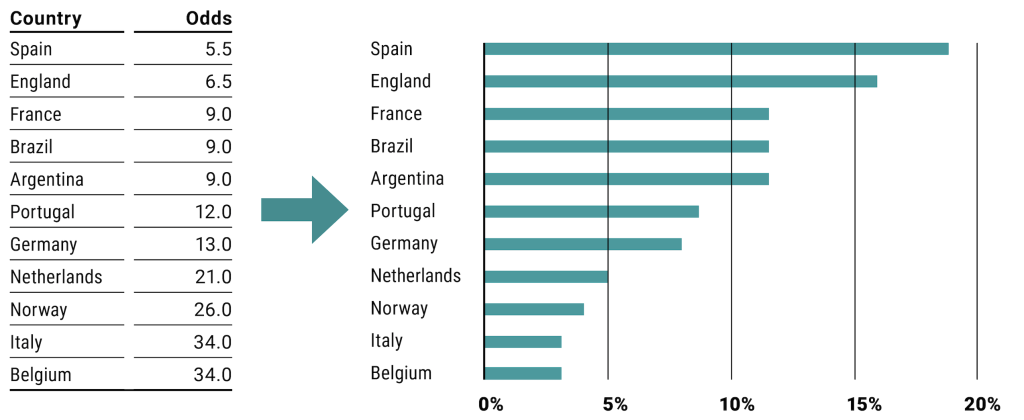
Source: Bet365, ESPN, VIG Asset Management
Status as of 19 March 2026
A new data source for Wall Street
Recently, the Intercontinental Exchange – the operator of the New York Stock Exchange – launched a new data service that gives investors access to changes in event-based odds from the Polymarket platform. These data reveal how collective expectations evolve regarding the probability of various events.
In the world of investing, this represents a new type of sentiment indicator. Just as betting odds in football signal the more likely winner, they can also be used to gauge market expectations around economic or political developments.
Why would wall street use this?
Institutional investors are constantly searching for new sources of information that can help them better understand future market movements and generate excess returns. Insights derived from betting markets may serve as an additional explanatory variable for future outcomes.
Since odds effectively represent probabilities, investors can incorporate them into a framework of expected returns and risk, allowing them to build more informed strategies.
Betting odds and their implied probabilities often provide a surprisingly accurate picture of relative strengths. At the same time, market expectations are gaining increasing attention as indicators of future movements. It is easy to imagine a scenario where major market shifts are not preceded by macroeconomic data releases, but rather by turning points in collective expectations.
Playing with the odds
Let’s imagine that we turn World Cup favorites into an investment portfolio. Countries are represented by equity indices, while their weights are determined by their probability of winning the tournament. As these probabilities change, the portfolio weights adjust accordingly.
The portfolio always consists of the 11 most likely contenders, which are currently as follows:
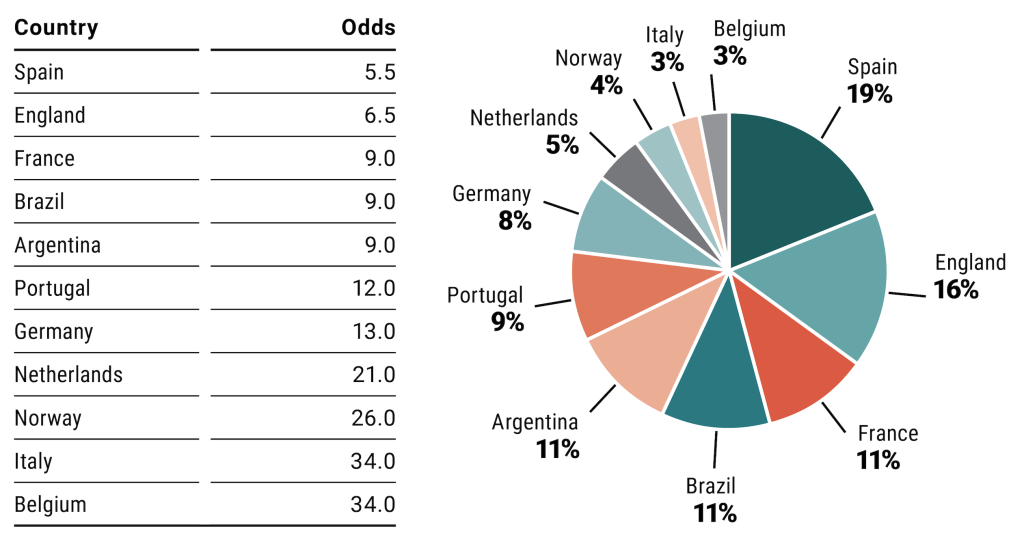
Source: Bet365, ESPN, VIG Asset Management
Status as of 19 March 2026
Overall, this results in a well-diversified hypothetical equity portfolio. It provides exposure to both developed and emerging markets, with a strong tilt toward Europe. This effectively suggests that football fans expect a European country to win this year’s World Cup.
We have been tracking the performance of this hypothetical portfolio since 2025, during which it has delivered notably strong returns:
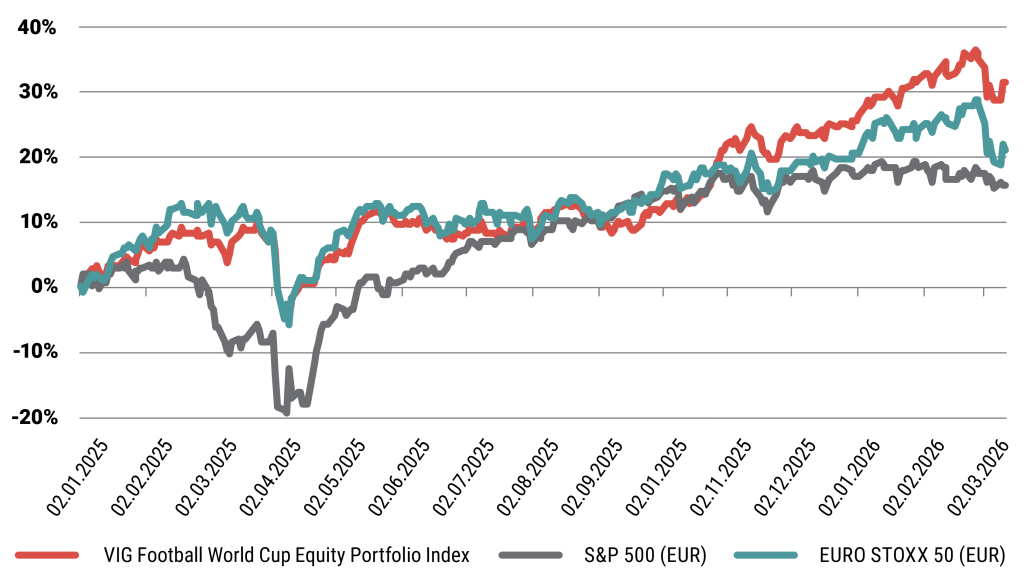
Source: VIG Asset Management
It seems that football fans’ expectations are not entirely unfounded even in capital markets.😎
Stay connected
Would you like to keep up to date with news and insights related to the performance of the VIG Football World Cup Equity Portfolio Index?
Follow us on our social media channels:
The portfolio presented and the related analyses are provided for informational purposes only and do not constitute investment advice, an offer, or a recommendation, nor do they form the basis for any investment decision. The performance presented is based on hypothetical calculations, is for informational purposes only, and does not reflect the past or future returns of any existing investment product.
The construction of the portfolio and the determination of probabilities involve the use of statistical models and methods based on artificial intelligence; any projections or forecasts regarding future performance are not guaranteed.
Jogi nyilatkozat: A blog üzemeltetője a VIG Befektetési Alapkezelő Magyarország Zrt., a szerzői az Alapkezelő munkavállalói. A weboldal kereskedelmi kommunikációt tartalmaz. A blogon megjelenő cikkek magánszemélyek szubjektív véleményét tükrözik, tájékoztatási céllal készülnek és nem minősülnek befektetési elemzésnek vagy befektetési tanácsadásnak és nem tartalmaznak befektetési ajánlást. A blog szerzői saját nevükben kereskedhetnek olyan pénzügyi és pénzeszközzel vagy más termékkel, amelyről az általuk készített cikk közöl tájékoztatást vagy véleményt. Bár a szerzők tőzsdei vagy tőzsdén kívüli kereskedés során szerzett tapasztalata a jelen blogon szereplő írásaikban is megjelenhet, de érdekeltség nem befolyásolhatja az általuk közölt tájékoztatást. A blogon megjelenő cikkekben, hírekben és tájékoztatásokban megjelenhetnek olyan társaságok, amelyek üzleti kapcsolatot tartanak fenn a VIG Befektetési Alapkezelő Magyarország Zrt.-vel vagy a blog szerzőivel akár közvetlenül, akár a VIG Group cégcsoportba tartozó más vállalkozáson keresztül. Jelen blogon megjelent cikkek nem tartalmaznak teljes körű tájékoztatást, és nem helyettesítik a befektetés megfelelőségének vizsgálatát, amelyet csak az adott befektető egyedi körülményeinek értékelésével lehet megállapítani. A megalapozott befektetési döntés meghozatalához kérjük, hogy részletesen és több forrásból tájékozódjon!
A VIG Befektetési Alapkezelő Magyarország Zrt., a blog szerkesztői és szerzői nem vállalnak felelősséget a blogon szereplő tartalom naprakészségéért, esetleges hiányosságaiért vagy pontatlanságaiért, valamint a blogcikkek alapján hozott befektetési döntésekért és a befektetési döntésekből származó bármilyen közvetlen vagy közvetett kárért vagy költségért.