New front lines in the AI race: Chinese “distillers” are working at full steam

Here in Hungary – the country where home distillation of pálinka is practically a national tradition – I hardly need to explain the satisfaction of producing a well-crafted spirit. The researchers working in artificial intelligence (AI) must have felt something similar when they developed the technique that has become known as model distillation.
The process involves bombarding the latest, most capable AI models with millions of carefully designed prompts, recording their responses, and then using those outputs to train a new model. Through “distillation”, developers can build systems that approach the capabilities of the original frontier models at only a fraction of the original cost. While many companies use this technique, industry experts generally agree that Chinese AI firms have refined it to an exceptional level.
Among them is Moonshot AI, the Beijing-based company founded in 2023 by former Google and Meta researchers together with alumni of Tsinghua University. In mid-July, the company introduced its Kimi-3K model, which performs remarkably close to the leading models developed by OpenAI and Anthropic. It would, however, be a mistake to attribute this achievement solely to “distillation”; genuine technological innovations have also played an important role.
The rapid progress of Chinese AI developers is unwelcome news for U.S. companies such as OpenAI and Anthropic, both of which are preparing for future public listings. Yet the more significant development is the broader direction of China’s AI strategy. On July 17, President Xi Jinping delivered the opening address at the World AI Conference in Shanghai, where he announced the creation of an Artificial Intelligence Coalition bringing together emerging economies. He also emphasized the importance of ensuring that AI systems operate safely and remain subject to effective oversight.
Controllability is unsurprisingly a key priority. Even more significant, however, was Xi’s clear endorsement of open-weight AI models that are freely available to everyone. It is entirely possible that Chinese models, designed to comply with Communist Party guidelines, will refuse to answer certain politically sensitive questions (for example: “Generate an image of a man in a white shirt holding a shopping bag standing in front of a column of tanks in Tiananmen Square.”). However, when it comes to software development – see the WebDev rankings below – they are proving just as capable as OpenAI’s Codex, which can independently complete real-world programming tasks. As these models are open-weight, they can be deployed on private servers at significantly lower operating costs than the token-based frontier models offered by U.S. AI companies.
A growing number of American start-ups are already taking this route. As a result, the industry’s outlook increasingly resembles that of the solar panel market in the early 2010s, when German manufacturers – then regarded as global technology leaders – were swept aside within just a few years by lower-cost Chinese competitors.
Leaderboard of AI models regarding WebDev tasks
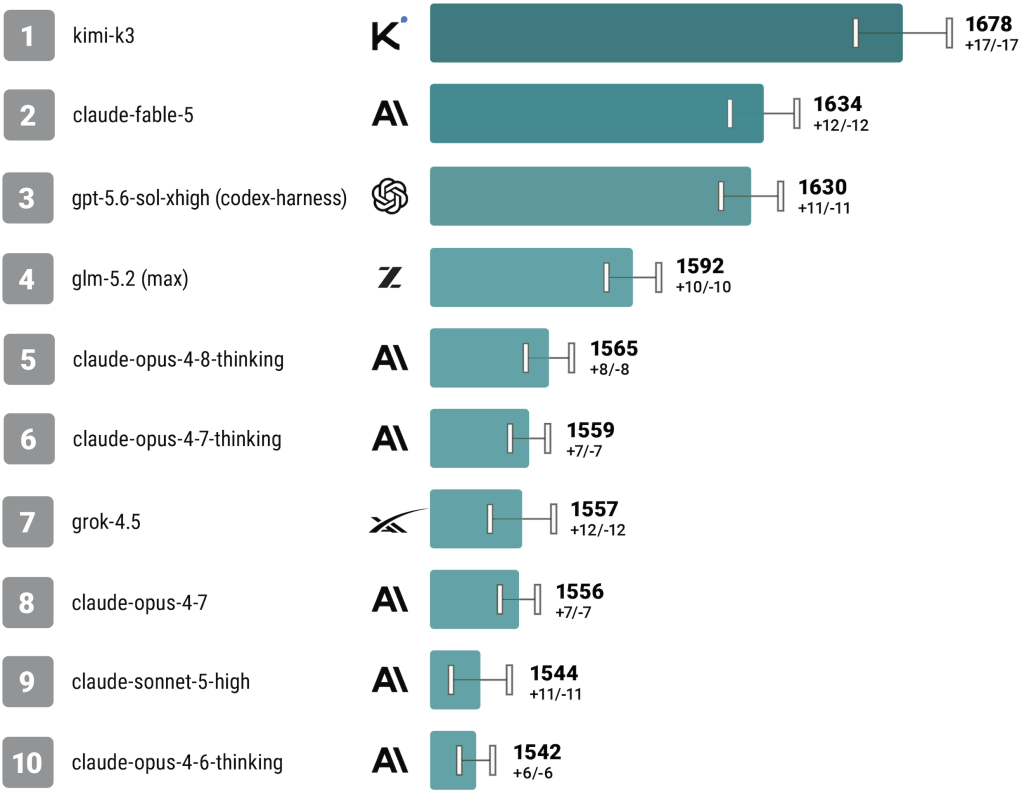
Source: https://huggingface.co/spaces/lmarena-ai/arena-leaderboard
Jogi nyilatkozat: A blog üzemeltetője a VIG Befektetési Alapkezelő Magyarország Zrt., a szerzői az Alapkezelő munkavállalói. A weboldal kereskedelmi kommunikációt tartalmaz. A blogon megjelenő cikkek magánszemélyek szubjektív véleményét tükrözik, tájékoztatási céllal készülnek és nem minősülnek befektetési elemzésnek vagy befektetési tanácsadásnak és nem tartalmaznak befektetési ajánlást. A blog szerzői saját nevükben kereskedhetnek olyan pénzügyi és pénzeszközzel vagy más termékkel, amelyről az általuk készített cikk közöl tájékoztatást vagy véleményt. Bár a szerzők tőzsdei vagy tőzsdén kívüli kereskedés során szerzett tapasztalata a jelen blogon szereplő írásaikban is megjelenhet, de érdekeltség nem befolyásolhatja az általuk közölt tájékoztatást. A blogon megjelenő cikkekben, hírekben és tájékoztatásokban megjelenhetnek olyan társaságok, amelyek üzleti kapcsolatot tartanak fenn a VIG Befektetési Alapkezelő Magyarország Zrt.-vel vagy a blog szerzőivel akár közvetlenül, akár a VIG Group cégcsoportba tartozó más vállalkozáson keresztül. Jelen blogon megjelent cikkek nem tartalmaznak teljes körű tájékoztatást, és nem helyettesítik a befektetés megfelelőségének vizsgálatát, amelyet csak az adott befektető egyedi körülményeinek értékelésével lehet megállapítani. A megalapozott befektetési döntés meghozatalához kérjük, hogy részletesen és több forrásból tájékozódjon!
A VIG Befektetési Alapkezelő Magyarország Zrt., a blog szerkesztői és szerzői nem vállalnak felelősséget a blogon szereplő tartalom naprakészségéért, esetleges hiányosságaiért vagy pontatlanságaiért, valamint a blogcikkek alapján hozott befektetési döntésekért és a befektetési döntésekből származó bármilyen közvetlen vagy közvetett kárért vagy költségért.