The New Golden Age of Video Gaming

Market Outlook, Key Trends, and Growth Drivers
One of the best-performing megatrends of the year has been tied to the companies behind video game development. But what’s driving this surge?
The world of video games has long since outgrown its traditional role as a niche entertainment sector. Today, it stands as a dominant, diverse, and increasingly investor-friendly global industry. In 2024, the global gaming market even surpassed total spending on professional sports. Following the explosive growth during the COVID-19 era, the sector appears to be entering another inflection point—fueled by breakthrough technologies (especially artificial intelligence), next-gen consoles, and a wave of long-anticipated major game releases. In the coming years, gaming’s influence will grow not just economically, but culturally as well.
The Main Growth Engines of the Gaming Sector
- The Global Gamer Population Could Reach 3 Billion
Although gaming experienced exceptional growth over the past decade, the post-pandemic correction slowed momentum, bringing the industry back to single-digit annual growth. From a 13% average yearly growth between 2017 and 2021, the pace dropped to just 1% by 2023. Future forecasts suggest a more moderate, yet steady, growth of around 5% annually. In 2024, the global gaming market is projected to be worth $221 billion, potentially rising to $266 billion by 2028.
This growth is not only quantitative, but structural and qualitative. The industry is transforming through new platforms, innovative business models, and technological breakthroughs that are redefining how games are developed, distributed, and consumed. By 2029, the global gaming population is expected to reach 3 billion – up 17% compared to 2024.
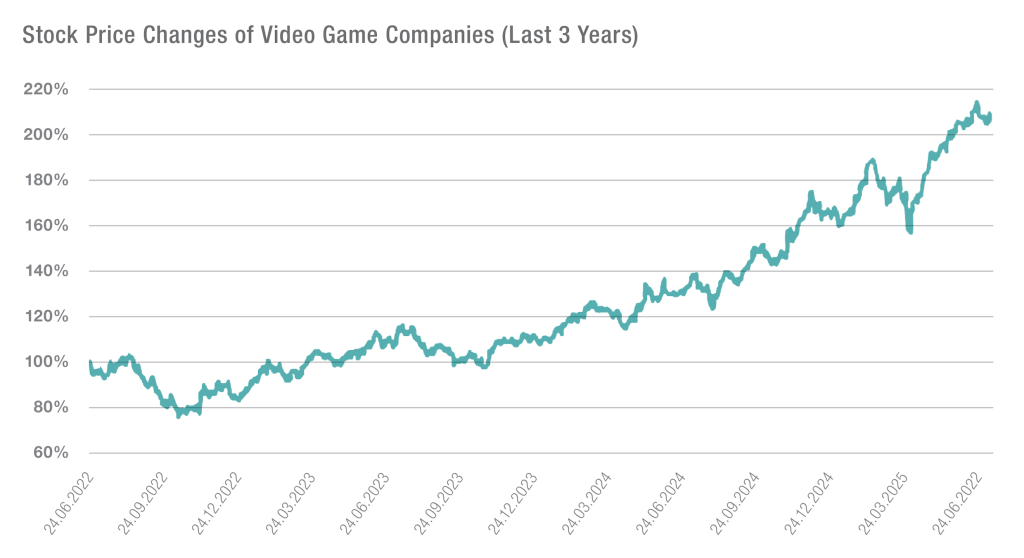
Source: Bloomber, VIG AM
- Cloud Gaming to Grow 25% Annually
Generative AI has ushered in a new era for gaming. AI doesn’t just personalize gameplay – it significantly reduces development costs and timelines. What once took years can now be prototyped in weeks. Automation and creative AI tools empower even small studios to release competitive products swiftly.
Meanwhile, the cloud gaming segment is expected to grow at a 25% annual rate, reaching $25 billion by 2029. Cloud infrastructure enables high-quality gaming regardless of a user’s hardware, attracting an even broader audience.
- Evolving Business Models
A key shift is the widespread adoption of Gaming-as-a-Service (GaaS) models. Instead of one-time purchases, developers now rely on recurring revenue streams through subscriptions, in-game purchases, and ongoing content updates. This approach offers more predictable and scalable income—even during periods when console sales or new game releases slow down.
- Even Boomers Are Playing All Day
Over 213 million Americans now play games regularly, with the average weekly playtime reaching 12.8 hours. The over-50 age group is also growing rapidly – from just 17% in 2004 to 29% in 2024.
Easing regulations have triggered a new growth cycle in markets like China, where the gaming sector grew by 7.5% in 2024, reaching $44.8 billion. Leading players include NetEase and Tencent. In Japan, the introduction of new hardware – like the Nintendo Switch 2 – is driving momentum. In 2025, Japanese gaming revenue could surpass $51 billion.
- Top Players Report Outstanding Results
Recent hit releases such as Call of Duty: Black Ops 6 and Helldivers II have greatly increased user engagement, helping leading publishers post strong performance in 2025.
- Electronic Arts (EA): Sports games, including EA Sports College Football 25, are among the best-performing segments. EA reported a record $7.35 billion in net bookings in fiscal 2025, with projections reaching $8 billion for 2026.
- Take-Two Interactive: Anticipation for GTA VI is historic. Its first trailer garnered over 475 million views in just 24 hours. GTA V generated over $8 billion in total revenue, making it the most successful entertainment product of all time.
- Sony and Nintendo: New game releases – often accompanied by hardware upgrades – continue to boost the console market, which is expected to grow by 20.9% through 2027. Sony has sold over 78 million PS5 consoles, while demand is rising thanks to exclusive titles. The Nintendo Switch 2 sold 3.5 million units within four days of launch, with a sales target of 15 million units for the 2026 fiscal year.
- Roblox: A prime example of social gaming success, Roblox reached 97.8 million daily active users in Q1 2025 – a 26% YoY increase. Annualized revenue is now over $4 billion, up 29% from the previous year.
Financial Stability, New Challenges, and the Road Ahead
As the market recalibrated post-pandemic, gaming companies streamlined operations, cut costs, and increasingly integrated AI tools. As a result, the industry’s financial foundations are more stable than ever. Free cash flow margins have significantly improved thanks to efficiency gains and cost reductions. Gaming is also relatively recession-resilient, with consumers maintaining digital entertainment habits even during economic slowdowns.
Still, challenges remain. The cost of developing AAA titles has outpaced revenue growth. On top of that, the industry faces regulatory, data privacy, consumer protection, and antitrust risksesp – ecially given its global exposure. Maintaining a strong pace of innovation remains critical for sustained growth.
Conclusion
The video game industry is no longer just a branch of the entertainment world—it has become a standalone global ecosystem. Driven by technological advancement, growing cultural acceptance, evolving business models, and regional expansion, gaming is on a growth trajectory that appears sustainable for the long term.
From an investment perspective, this megatrend offers a rare combination of innovation, stability, and resilience across economic cycles – making it one of the foundational pillars of future digital entertainment. This is why the VIG MegaTrend Equity Investment Fund considers the gaming sector a key component of its portfolio.
Source: GlobalX Insights; BCG, The Future of Global Gaming Industry; BCG, The gaming report
VIG MegaTrend Equity Investment Fund
The VIG MegaTrend Equity Investment Fund aims to benefit from global megatrends that transcend economic cycles.
These include demographic changes (aging populations, emerging markets), efficiency gains from limited resources (renewable energy, energy efficiency), urbanization, and technological innovation.
The fund is managed by Péter Richter, Senior Equity Portfolio Manager.
“The authors contributing to this blog accept no responsibility for any investment decisions made or for any consequences arising from their articles published on the blog, nor for any potential omissions or inaccuracies in the information provided on the website. The articles appearing on this blog reflect the subjective opinions of private individuals and do not constitute investment analysis or recommendations.”
Jogi nyilatkozat: A blog üzemeltetője a VIG Befektetési Alapkezelő Magyarország Zrt., a szerzői az Alapkezelő munkavállalói. A weboldal kereskedelmi kommunikációt tartalmaz. A blogon megjelenő cikkek magánszemélyek szubjektív véleményét tükrözik, tájékoztatási céllal készülnek és nem minősülnek befektetési elemzésnek vagy befektetési tanácsadásnak és nem tartalmaznak befektetési ajánlást. A blog szerzői saját nevükben kereskedhetnek olyan pénzügyi és pénzeszközzel vagy más termékkel, amelyről az általuk készített cikk közöl tájékoztatást vagy véleményt. Bár a szerzők tőzsdei vagy tőzsdén kívüli kereskedés során szerzett tapasztalata a jelen blogon szereplő írásaikban is megjelenhet, de érdekeltség nem befolyásolhatja az általuk közölt tájékoztatást. A blogon megjelenő cikkekben, hírekben és tájékoztatásokban megjelenhetnek olyan társaságok, amelyek üzleti kapcsolatot tartanak fenn a VIG Befektetési Alapkezelő Magyarország Zrt.-vel vagy a blog szerzőivel akár közvetlenül, akár a VIG Group cégcsoportba tartozó más vállalkozáson keresztül. Jelen blogon megjelent cikkek nem tartalmaznak teljes körű tájékoztatást, és nem helyettesítik a befektetés megfelelőségének vizsgálatát, amelyet csak az adott befektető egyedi körülményeinek értékelésével lehet megállapítani. A megalapozott befektetési döntés meghozatalához kérjük, hogy részletesen és több forrásból tájékozódjon!
A VIG Befektetési Alapkezelő Magyarország Zrt., a blog szerkesztői és szerzői nem vállalnak felelősséget a blogon szereplő tartalom naprakészségéért, esetleges hiányosságaiért vagy pontatlanságaiért, valamint a blogcikkek alapján hozott befektetési döntésekért és a befektetési döntésekből származó bármilyen közvetlen vagy közvetett kárért vagy költségért.