More, more, more – and still not enough

That seems to be the motto of the world’s largest tech companies, as they continue to pour unprecedented sums into artificial intelligence. Investors, however, are drawing a line: patience is limited, and the clock is ticking for those who fail to deliver tangible returns.
Last week, companies representing 44% of the S&P 500’s market capitalization released their earnings – including all the major technology giants. The spectacle didn’t disappoint: data center investments are not only maintaining their pace but are expected to accelerate through 2026, powered by immense structural demand. This is no passing trend – the AI investment boom is the driving engine of today’s bull market.
The U.S. tech titans – Meta Platforms, Microsoft, Amazon.com, and Alphabet (Google) – plan to invest a combined total of over $400 billion in AI infrastructure this year alone (covering data centers, chips, and cloud services). And even that, according to their executives, won’t be enough.
Meta continues to struggle with capacity shortages as it simultaneously trains new AI models and runs existing products. Microsoft faces overwhelming customer demand for its cloud services and aims to double its data center capacity within two years. Amazon is also racing against time to deploy new cloud infrastructure as quickly as possible.
AI is no longer the future – it is the business of today. (Investors who believe in this trend might explore the VIG InnovationTrend ESG Equity Fund, where artificial intelligence is one of the central themes and major tech names are among the fund’s top holdings.)
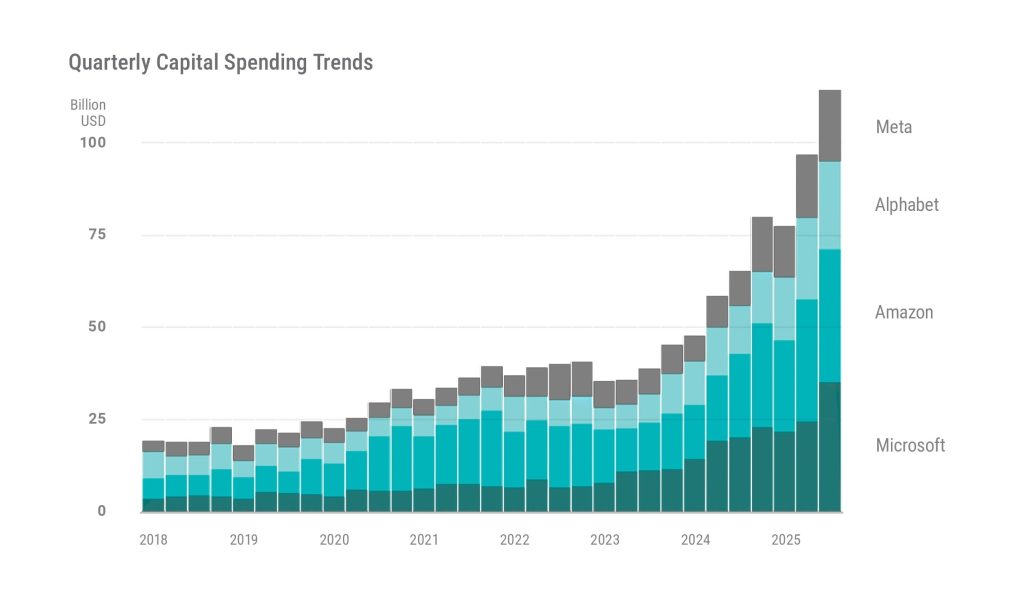 Source: WSJ, https://www.wsj.com/tech/ai/big-tech-is-spending-more-than-ever-on-ai-and-its-still-not-enough-f2398cfe?mod=Searchresults&pos=1&page=1
NVIDIA: The Engine of the AI Revolution
NVIDIA did not release a financial report, but instead made headlines at a developer conference with a wave of groundbreaking AI announcements. The company unveiled new strategic partnerships, massive projects, and forward-looking initiatives. It is acquiring nearly a 3% stake in Nokia for $1 billion, collaborating on the development of 6G mobile network technology.
In partnership with the U.S. Department of Energy, NVIDIA is building seven AI supercomputers, including systems designed to support nuclear research and quantum development. Starting in 2027, it will equip 100,000 autonomous vehicles with NVIDIA chips in collaboration with Uber.
Further initiatives include healthcare robotics development with Johnson & Johnson, an AI supercomputer for pharmaceutical research with Eli Lilly, and new partnerships with Palantir and CrowdStrike. The company also announced a backlog of AI chip orders worth $500 billion—more than double its projected revenue for this year.
NVIDIA is no longer positioning itself as “just” a chip manufacturer; it aims to become a cornerstone of the AI era, with its technology playing a role in every major technological revolution.
Microsoft: Investing Heavily in Cloud and AI Growth
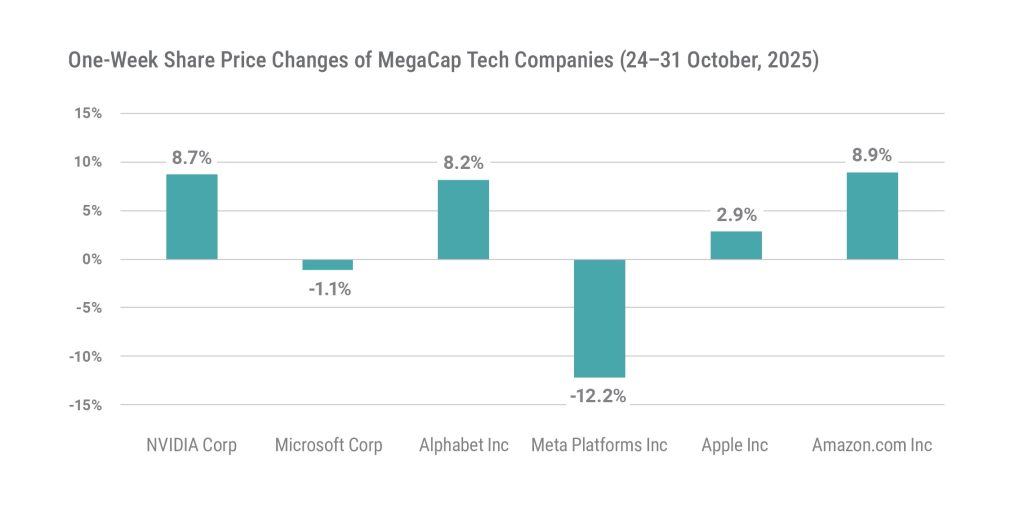
Microsoft once again beat expectations – yet its stock slipped. The reason: record capital expenditures. Revenue hit $77.7 billion (+18%), driven by Azure’s 39% growth, one of the fastest in the market. CapEx soared to $34.9 billion, up from $24 billion last quarter. CEO Satya Nadella said demand is so strong that Microsoft will double its data center footprint within two years and increase AI capacity by 80% this year. The company remains one of the biggest winners of the AI boom — but investors now expect to see concrete returns.
Alphabet (Google): AI-Fueled Acceleration
Alphabet exceeded all expectations: revenue reached $102.3 billion (+16%), and EPS was $2.87 (vs. $2.26 expected). Google Cloud grew 34% year-over-year, while capital spending climbed to $91–93 billion. The company’s Gemini model now reaches 650 million monthly users, closing in on ChatGPT’s global lead. Alphabet has proven it can monetize AI, and investors rewarded it with an 8% stock price jump.
Meta: Betting Big on AI, but Uncertainty Remains
Meta (Facebook, Instagram, WhatsApp) reported strong growth but rising costs. Revenue came in at $51.2 billion (+26%), but profits were hit by a one-off tax item. Annual investments are expected to reach $70–72 billion, possibly $100 billion next year. CEO Mark Zuckerberg spoke about building “superintelligence” — AI that could surpass human capabilities.Investors remain cautious, questioning whether such massive spending will pay off. Still, AI-driven algorithms already boost engagement: Facebook usage is up 5%, Instagram 30% — good news for advertisers.
Apple: A Quiet Quarter with Promising Outlook
Apple delivered solid but modest growth: Revenue $102.5 billion (+8%), EPS $1.85 (vs. $1.77 expected). Services revenue hit $28.8 billion (+15%), the fastest-growing segment. China was weak, but CEO Tim Cook cited supply issues, not waning demand. While Apple remains behind in AI innovation, its services growth and strong cash generation provide a solid foundation — though investors question whether it justifies current valuations.
Amazon: Back on a Strong Growth Track
Amazon surprised even optimists with an exceptionally strong quarter: Revenue $180 billion (+12%), profit $21 billion (+40%), AWS growth +20%, and ad revenue up 22%. CEO Andy Jassy announced plans to invest $125 billion next year, doubling data center capacity and advancing AI-powered logistics and automation. Amazon has reclaimed its leadership position in both the cloud and AI race.
Source: VIG AM, Bloomberg
The recent stock price movements clearly reflect the mixed reactions among investors, stemming from uncertainty about whether these massive expenditures will ultimately pay off. The market’s response to the earnings of the major technology giants this week indicates that investors are willing to tolerate surging capital expenditures only when they are backed by strong earnings growth and credible prospects for monetizing AI investments in the future.
Investors Split on the AI Spending Frenzy
Stock movements reveal mixed reactions. The market is now clearly distinguishing between AI investments backed by real revenue growth and those driven mainly by ambition.
Investors are divided into two camps:
- The believers argue that these massive investments are essential to reach Artificial General Intelligence (AGI) – the level where AI surpasses human intellect. Whoever gets there first will enjoy an unassailable competitive advantage.
- The skeptics question whether multi-billion-dollar large language models (LLMs) will ever deliver on that promise, noting that paid user adoption remains limited and widespread productivity gains are still years away.
One thing is certain: the AI race is far from over – and the stakes have never been higher.
Jogi nyilatkozat: A blog üzemeltetője a VIG Befektetési Alapkezelő Magyarország Zrt., a szerzői az Alapkezelő munkavállalói. A weboldal kereskedelmi kommunikációt tartalmaz. A blogon megjelenő cikkek magánszemélyek szubjektív véleményét tükrözik, tájékoztatási céllal készülnek és nem minősülnek befektetési elemzésnek vagy befektetési tanácsadásnak és nem tartalmaznak befektetési ajánlást. A blog szerzői saját nevükben kereskedhetnek olyan pénzügyi és pénzeszközzel vagy más termékkel, amelyről az általuk készített cikk közöl tájékoztatást vagy véleményt. Bár a szerzők tőzsdei vagy tőzsdén kívüli kereskedés során szerzett tapasztalata a jelen blogon szereplő írásaikban is megjelenhet, de érdekeltség nem befolyásolhatja az általuk közölt tájékoztatást. A blogon megjelenő cikkekben, hírekben és tájékoztatásokban megjelenhetnek olyan társaságok, amelyek üzleti kapcsolatot tartanak fenn a VIG Befektetési Alapkezelő Magyarország Zrt.-vel vagy a blog szerzőivel akár közvetlenül, akár a VIG Group cégcsoportba tartozó más vállalkozáson keresztül. Jelen blogon megjelent cikkek nem tartalmaznak teljes körű tájékoztatást, és nem helyettesítik a befektetés megfelelőségének vizsgálatát, amelyet csak az adott befektető egyedi körülményeinek értékelésével lehet megállapítani. A megalapozott befektetési döntés meghozatalához kérjük, hogy részletesen és több forrásból tájékozódjon!
A VIG Befektetési Alapkezelő Magyarország Zrt., a blog szerkesztői és szerzői nem vállalnak felelősséget a blogon szereplő tartalom naprakészségéért, esetleges hiányosságaiért vagy pontatlanságaiért, valamint a blogcikkek alapján hozott befektetési döntésekért és a befektetési döntésekből származó bármilyen közvetlen vagy közvetett kárért vagy költségért.