AI is also affecting “green stocks”

Solar plus storage is emerging as the only solution that can be scaled up in the short term.
This year, the global benchmark for clean energy stocks has far outperformed the major stock indices and generated nearly as much return as gold. The S&P Global Clean Energy index, which tracks the average price change of a wide range of global renewable energy companies, has achieved a return of approximately 51.5% in US dollars since the beginning of the year through mid-November.
What is behind the rise?
After two years of a bear market and continuous capital outflows, a fundamental change in the outlook for U.S. electricity demand and the greater political predictability are once again attracting investors. Valuations have become so detached from fundamentals that even confirmation of negative news has become a positive catalyst. U.S. President Donald Trump’s “One Big Beautiful Bill” package (which introduces new restrictions on energy tax credits) has had a significant impact on the renewable energy industry. However, the outcome was far less negative than many had feared and provides enough predictability for investors to recommit and companies to continue their projects.
Investors are increasingly optimistic about renewable energy stocks as it becomes increasingly clear that the energy required to power artificial intelligence cannot be provided without renewables. So, the current rally is also being driven by growing electricity demand, generated by rapid investment in AI data centers by large technology companies, the electrification of transportation and industry, and the development of network infrastructure (to enable the latter to handle the increased load). Electricity consumption in the United States, which has stagnated for more than a decade, is now poised for steep growth. With a shortage of gas turbines and nuclear projects still years away, solar plus storage is emerging as the only scalable solution in the short term.
For investors seeking to benefit from this trend, the VIG GreenTrend Equity Investment Fund may offer an attractive opportunity, as a significant portion of its portfolio consists of shares in the renewable energy sector. The primary goal of the fund is sustainable investment: it aims to generate profits while also having a positive impact on environmental and social processes.
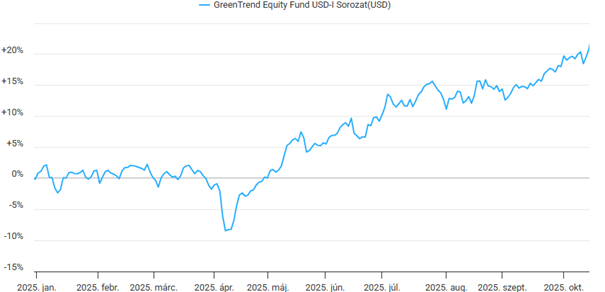
Source: VIG Asset Management
These trends show that the renewable energy sector is shifting from a subsidy-driven model to a market that is primarily shaped by demand, where strong demand requires the involvement of all energy sources. This is starting to give companies real momentum for growth, especially those involved in AI, data centers, or networking. Artificial intelligence-driven energy demand could double by 2028, favouring rapidly deployable solar, energy storage, and gas capacities.
However, even so, the rise in S&P’s clean energy index is still only half of what it was in 2021, when green investments were at their peak and interest rates were at historic lows. Now, however, the Federal Reserve’s more dovish tone is also benefiting the market. Investors are increasingly pricing in a cautious easing cycle after interest rates peak. Lower borrowing costs are an advantage for capital-intensive renewable energy projects, although interest rates are still well above the extremely low levels seen during the heyday of sustainability investments.
Why does the market continue to view renewables as a structural megatrend?
Those who have invested in renewable energy stocks over the past 5-6 years have experienced the phases of the so-called “Gartner hype cycle” curve, which illustrates the maturity, adaptation, and social application of individual technologies. However, after the “green bubble” of 2020-21 and the interest rate shock of 2022-23, the sector’s stocks have recovered significantly by 2025, and the outlook remains positive. This year, wind and solar energy together exceeded coal’s share of global electricity generation for the first time, marking a structural turning point in the energy mix. According to the International Energy Agency’s (IEA) main scenario, between 2023 and 2030, renewable energy consumption will increase by nearly 60%, with the share of renewables in final energy consumption rising from 13% to almost 20%, and in electricity generation from 30% to 46%. The EMSZ’s goal of tripling capacity by 2023, as committed to at the COP28 climate change conference, implicitly sets a “floor” for renewable investments: if the pace slows, even greater efforts (and support intensity) will be needed in the coming years.
The sector’s prospects naturally depend on interest rate trends and political decisions, but the need to transform the energy system means that the investment cycle is likely to remain strong. In the long term, renewables clearly represent a structural megatrend, supported by record investments, lasting cost advantages, climate targets and regulatory support, as well as the turning points already visible in global electricity generation (wind+solar > coal).
Jogi nyilatkozat: A blog üzemeltetője a VIG Befektetési Alapkezelő Magyarország Zrt., a szerzői az Alapkezelő munkavállalói. A weboldal kereskedelmi kommunikációt tartalmaz. A blogon megjelenő cikkek magánszemélyek szubjektív véleményét tükrözik, tájékoztatási céllal készülnek és nem minősülnek befektetési elemzésnek vagy befektetési tanácsadásnak és nem tartalmaznak befektetési ajánlást. A blog szerzői saját nevükben kereskedhetnek olyan pénzügyi és pénzeszközzel vagy más termékkel, amelyről az általuk készített cikk közöl tájékoztatást vagy véleményt. Bár a szerzők tőzsdei vagy tőzsdén kívüli kereskedés során szerzett tapasztalata a jelen blogon szereplő írásaikban is megjelenhet, de érdekeltség nem befolyásolhatja az általuk közölt tájékoztatást. A blogon megjelenő cikkekben, hírekben és tájékoztatásokban megjelenhetnek olyan társaságok, amelyek üzleti kapcsolatot tartanak fenn a VIG Befektetési Alapkezelő Magyarország Zrt.-vel vagy a blog szerzőivel akár közvetlenül, akár a VIG Group cégcsoportba tartozó más vállalkozáson keresztül. Jelen blogon megjelent cikkek nem tartalmaznak teljes körű tájékoztatást, és nem helyettesítik a befektetés megfelelőségének vizsgálatát, amelyet csak az adott befektető egyedi körülményeinek értékelésével lehet megállapítani. A megalapozott befektetési döntés meghozatalához kérjük, hogy részletesen és több forrásból tájékozódjon!
A VIG Befektetési Alapkezelő Magyarország Zrt., a blog szerkesztői és szerzői nem vállalnak felelősséget a blogon szereplő tartalom naprakészségéért, esetleges hiányosságaiért vagy pontatlanságaiért, valamint a blogcikkek alapján hozott befektetési döntésekért és a befektetési döntésekből származó bármilyen közvetlen vagy közvetett kárért vagy költségért.