Nothing can stop the BUX – Is 200,000 the next target?

Just over a year ago, in July 2025, the BUX index – which tracks the average share price performance of the largest companies listed on the Hungarian stock exchange – crossed the 100,000 point mark for the first time in its history.
At the time, the key question was whether Hungary’s leading blue-chip stocks still had further upside potential after several years of exceptionally strong gains, despite weak domestic GDP growth and an approaching parliamentary election.
Today, the BUX is already above 150,000 points. The question has therefore shifted: is there anything that can stop the market rally, or is a move towards 200,000 points a realistic scenario?
Two main factors are driving the rise: earnings growth at Hungary’s largest listed companies – the blue chips – and a decline in Hungary’s risk premium. The former supports higher profits, while the latter justifies higher valuation multiples.
The key question is whether the BUX remains attractive at current price levels.
Why is the BUX rising so rapidly?
The BUX’s gains this year have been supported simultaneously by falling yields and continued earnings growth among the blue-chip companies.
The 10-year Hungarian government bond yield, a key indicator of investor confidence in Hungary, has fallen from 7.48% to 5.44% in just five months following the new government’s more pro-European policy shift. This roughly 200-basis-point decline directly supports equity valuations: lower interest rates improve the outlook for economic growth while reducing the relative attractiveness of bond investments. This has been one of the most important drivers of the BUX’s approximately 33% gain this year.
The improving fiscal position provides further support. The budget surplus recorded in July, together with an approximately HUF 1,000 billion improvement in the fiscal balance since April, may further reduce the risk premium attached to Hungarian assets.
At the same time, the operating performance of the four major blue-chip companies is also supporting the equity market.
OTP Bank, which represents the most important transmission mechanism between the improving macroeconomic environment and index performance, achieved a normalised return on equity (ROE) of 21%, alongside 8% FX-adjusted loan growth, an expected net interest margin (NIM) above 4.34%, and more than EUR 3 billion of excess capital.
MOL’s earnings per share (EPS) jumped 38.7% year-on-year, driven primarily by improving refining margins. With a P/E ratio of 8.7x, the oil company is currently the cheapest Hungarian blue chip. At the same time, its 4.2% net margin means that it remains particularly sensitive to swings in commodity-market cycles.
At Magyar Telekom, inflation-linked pricing and growth in the IT/IS segment prompted management to raise its 2026 guidance, with adjusted net income expected to grow by around 10% and free cash flow projected to reach at least HUF 200 billion. The company continues to benefit from the pass-through of inflation into pricing.
At Richter Gedeon, the outlook for adjusted EBIT was upgraded to double-digit growth at constant exchange rates, supported by Vraylar royalties. US pharmaceutical company AbbVie expects Vraylar revenues of approximately USD 4.1 billion in 2026. The active ingredient in the atypical antipsychotic, cariprazine, was developed by Hungary’s Richter Gedeon.
The rally is therefore being driven by both higher earnings and higher valuations. The key question now is which of these two factors still offers more upside.
There appears to be further potential not only in earnings growth, but also in valuation re-rating. As of August, the BUX is trading at an approximately 30% discount to its 2014 valuation peak and around 14% below the Polish market, which can be regarded as a relevant peer.
Hungary’s forward-looking equity risk premium (ERP) stands at 5.43%, compared with 3.17% in Poland and 2.84% in the Czech Republic. This suggests that the market is still pricing a higher risk premium for Hungary than for neighbouring countries.
If fiscal consolidation continues, the outlook for EU funding improves, and the National Bank of Hungary cuts interest rates, a further decline in both the ERP and bond yields could trigger additional multiple expansion.
In other words, the Hungarian equity rally could continue even if earnings growth slows, provided that the risk premium continues to narrow.
The key downside risk would be a loss of momentum in fiscal consolidation or a deterioration in global risk appetite. In such a scenario, the profit growth that is already partly priced into the market may not be sufficient on its own to generate another significant re-rating.
When could the BUX reach 200,000 points?
From its August level of approximately 150,000 points, the BUX would need to rise by a further roughly 33% to reach 200,000.
A combination of three factors could provide the basis for such a move:
| Driver | Assumption | Potential impact |
| Falling yields | The Hungarian 10-year government bond yield declines from 5.44% to around 3.8%, implying partial convergence towards euro-area levels; the National Bank of Hungary cuts its policy rate from 5.75% to 3–4%. | The P/E multiple expands from 9.2x to around 14x; even with unchanged earnings, this could re-rate the index towards approximately 200,000 points. |
| ERP compression | Hungary’s forward-looking ERP narrows from 5.43% towards Poland’s 3.17% or the Czech Republic’s 2.84% as macroeconomic credibility improves. | Reinforces multiple expansion; every 100-basis-point decline in the ERP could lift the index by approximately 10–12%. |
| Earnings growth | Consensus expects EPS growth of 12% in 2026 and 6% in 2027; OTP’s two-year EPS growth excluding Russia is estimated at 16%. | Raises the earnings base by approximately 18–20% over two years, amplifying the effect of multiple expansion. |
If all three conditions are met, the 200,000-point level could be reached by the end of 2027.
Faster fiscal consolidation or improved access to EU funds could bring this date forward to mid-2027. By contrast, if earnings continue to grow but yield and ERP convergence fail to materialise, the target may be more realistic only around 2029–2030.
Is the BUX still worth investing in?
Even after its substantial rise, the BUX does not appear expensive relative to other Central European equity markets.
The index offers a dividend yield of close to 4.7% and an ROE of more than 14%. Meanwhile, based on one-year forward P/E, it still trades at an approximately 13.5% discount to the CETOP index, which reflects the performance of the largest and most liquid publicly listed companies in Central Europe, as shown in the chart.
One-year forward P/E ratio
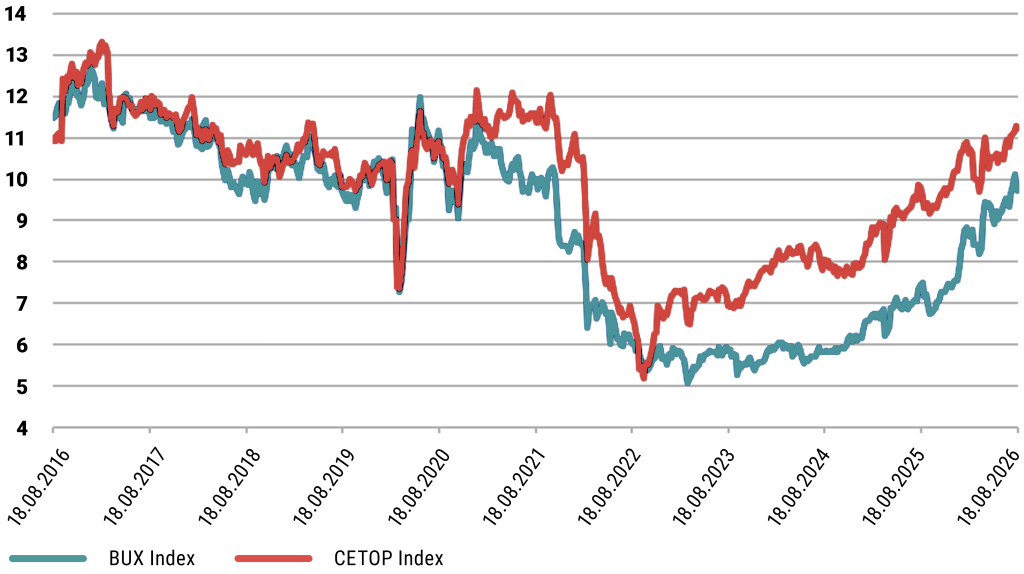
Source: Bloomberg (2026)
Hungary’s forward P/E of 9.2x is 12.5% above the BUX’s 10-year historical average. However, this premium can partly be justified by the fact that index-level ROE is currently around 3 percentage points above its historical average.
Higher profitability can in itself justify a higher sustainable valuation, which means that the current multiple should not automatically be regarded as expensive simply because it exceeds its historical average. That said, the market has already priced in part of the improvement in Hungary’s macroeconomic outlook. Further upside may therefore require not only continued earnings growth, but also an additional decline in the risk premium.
The investment case is consequently built primarily around further convergence. If the fiscal position continues to improve, the ERP and bond yields decline further, and blue-chip earnings continue to grow, the 200,000-point target could become realistic.
However, if fiscal improvement or earnings growth falls short of expectations, current valuations leave less room for disappointment.
Jogi nyilatkozat: A blog üzemeltetője a VIG Befektetési Alapkezelő Magyarország Zrt., a szerzői az Alapkezelő munkavállalói. A weboldal kereskedelmi kommunikációt tartalmaz. A blogon megjelenő cikkek magánszemélyek szubjektív véleményét tükrözik, tájékoztatási céllal készülnek és nem minősülnek befektetési elemzésnek vagy befektetési tanácsadásnak és nem tartalmaznak befektetési ajánlást. A blog szerzői saját nevükben kereskedhetnek olyan pénzügyi és pénzeszközzel vagy más termékkel, amelyről az általuk készített cikk közöl tájékoztatást vagy véleményt. Bár a szerzők tőzsdei vagy tőzsdén kívüli kereskedés során szerzett tapasztalata a jelen blogon szereplő írásaikban is megjelenhet, de érdekeltség nem befolyásolhatja az általuk közölt tájékoztatást. A blogon megjelenő cikkekben, hírekben és tájékoztatásokban megjelenhetnek olyan társaságok, amelyek üzleti kapcsolatot tartanak fenn a VIG Befektetési Alapkezelő Magyarország Zrt.-vel vagy a blog szerzőivel akár közvetlenül, akár a VIG Group cégcsoportba tartozó más vállalkozáson keresztül. Jelen blogon megjelent cikkek nem tartalmaznak teljes körű tájékoztatást, és nem helyettesítik a befektetés megfelelőségének vizsgálatát, amelyet csak az adott befektető egyedi körülményeinek értékelésével lehet megállapítani. A megalapozott befektetési döntés meghozatalához kérjük, hogy részletesen és több forrásból tájékozódjon!
A VIG Befektetési Alapkezelő Magyarország Zrt., a blog szerkesztői és szerzői nem vállalnak felelősséget a blogon szereplő tartalom naprakészségéért, esetleges hiányosságaiért vagy pontatlanságaiért, valamint a blogcikkek alapján hozott befektetési döntésekért és a befektetési döntésekből származó bármilyen közvetlen vagy közvetett kárért vagy költségért.