A red sun in the sky
On 27 July 2026 the most valuable segments of the Western tech sector came under attack on three fronts.
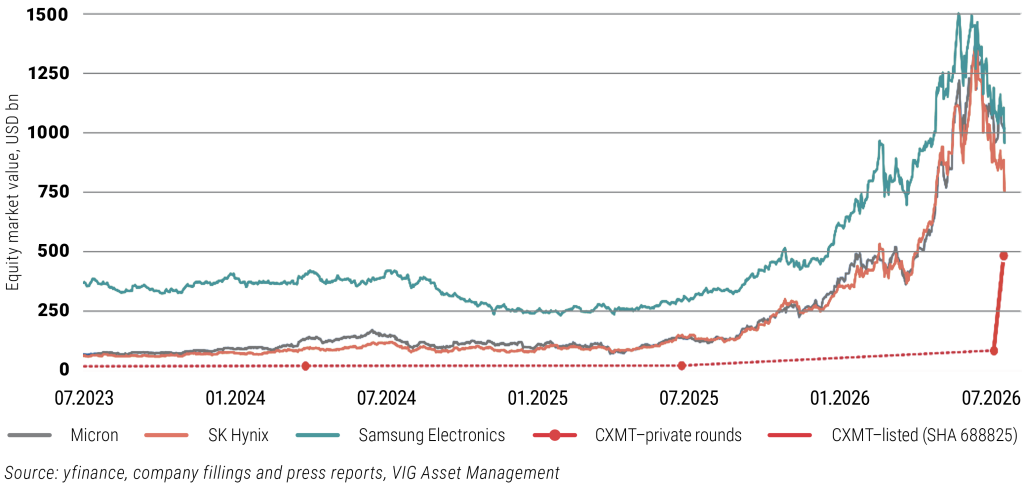
In the morning in Shanghai, shares of the Chinese semiconductor manufacturer ChangXin Memory (CXMT) began trading at 49.50 yuan after an issue price of 8.66 yuan, and by the end of the day stood roughly 470% higher. Its capitalisation of 3.3 trillion yuan corresponds to nearly $490 billion. In the course of a single morning the memory manufacturer overtook ICBC and became the most valuable company on the Chinese exchanges. This market had until now been in the hands of America’s Micron, South Korea’s SK Hynix and Samsung, all three of which reached a $1 trillion valuation on the back of the AI trend. A Chinese entrant carries numerous risks for them. CXMT’s pricing is highly competitive, and it cannot be expected to show the kind of supply discipline the other chipmakers exercise in order to avoid oversupply. Dumping by a Chinese memory manufacturer could on its own break the rally of the three chip giants. Realistically this scenario is several years away, but the long-term market position of today’s leading memory manufacturers looks fragile.
Thirteen months from private mark to peer
CXMT’s Shanghai debut vaulted it into the same valuation bracket as the incumbent DRAM makers
The same day brought news that a state-backed company in Shanghai had begun small-series production of Chinese-developed immersion DUV lithography machines (which can draw extremely fine circuit patterns onto silicon wafers). Shares in the current market leader, the Dutch company ASML (which derives 30% of its revenue from Chinese customers) fell 6% on the news. The Dutch lithography equipment maker is one of the strongest monopolies in technology markets and Europe’s most valuable company. The long-term erosion of its market position, however, is becoming increasingly likely. Chinese production volumes would allow the delivery of 5 DUV machines in 2026 and a further 20 in 2027, which will most likely land first at Chinese chipmakers and tech giants. For now this is dwarfed by the more than 100 DUV machines ASML delivers each year, and there is no evidence that this equipment is capable of the same performance (yield, throughput) as ASML’s machines. In EUV lithography ASML may retain its monopoly position for the next few years. The tightness of chip supply gives cyclical tailwinds to the “wafer fabrication equipment” (WFE) sector that builds integrated circuits, so weak demand for ASML’s machines is unlikely in the short term. Even so, the threat is real, and it is another data point suggesting that the Western technological lead is not invulnerable.
Also on that day, Beijing-based Moonshot AI uploaded the full weights of Kimi K3 to Hugging Face. With 2.8 trillion parameters it is the largest open-weight model ever released. The developer lab has faced accusations of distillation and chip smuggling, but K3’s near-frontier capabilities are undeniable. This undermines the pricing power of the closed American AI labs and calls into question the durability of their competitive advantage. It is a kind of indicator of AI dumping: Chinese open labs, working from orders of magnitude fewer resources, offer somewhat weaker but far cheaper models, thereby squeezing out the Western labs.
All three stories reinforce the view that the Chinese tech sector’s lag behind the West is minimal, and that with its often state-supported strategy, which is not primarily profit-driven, the sector is capable of disrupting the Western tech giants.
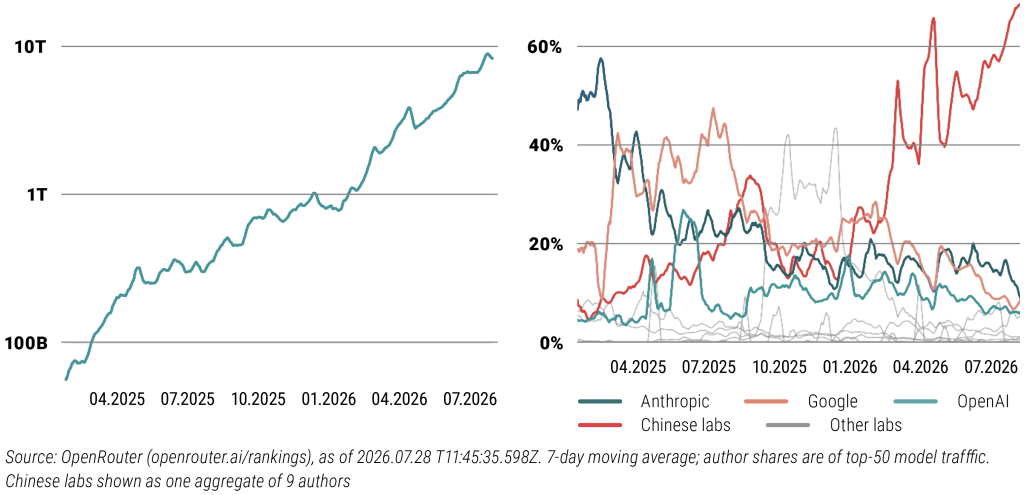
OpenRouter traffic is up 145-fold, and Chinese models now carry most of it
Anthropic, OpenAI and Google took 74% of routed tokens in January 2025 and 27% over the past month;Chinese labs went from 6% to 65%
Return Download
This is a marketing communication. Making a well-informed investment decision requires obtaining detailed information. Please read the Key Information Document, the official prospectus, and the management regulations available at the distribution points of the Fund and on the website of the Fund Manager (www.vigam.hu) for detailed information regarding the Fund’s investment policy, distribution costs, and the possible risks of investing. Costs related to the distribution of the investment fund (purchase, holding, sale) can be found in the Fund’s management regulations and at the distribution points. Past performance is not a reliable indicator of future returns. Future returns from the investment may be subject to taxation, and tax and duty information relating to individual financial instruments and transactions can only be accurately assessed based on the individual circumstances of each investor, which may change in the future. It is the investor’s responsibility to obtain information regarding tax obligations.
The data contained in this information material are provided for informational purposes only and do not constitute investment advice, an offer, or investment consulting. VIG Investment Fund Management Hungary Ltd. accepts no liability for investment decisions made based on this information or for their consequences. The license number of the Fund Manager for alternative investment fund management (AIFM) is: H-EN-III-6/2015. The license number of the Fund Manager for UCITS fund management (collective portfolio management) is: H-EN-III-101/2016.