Wall Street’s new indicator: betting odds

What do betting odds tell us?
Sports enthusiasts know that if you want to identify the favorites in a tournament, all you need to do is look at bookmakers’ odds. These figures are not just payout ratios – they also represent implied probabilities. Since they are formed by a broad market of actively engaged participants, they provide a strong reflection of collective expectations.
When a team’s odds shorten, it indicates that more people believe in their chances of winning. On the other hand, when odds lengthen, the market is shifting its expectations toward the opposing team. In other words, betting odds function as a continuous measure of public sentiment.
This is clearly illustrated by expectations for the 2026 FIFA World Cup. The most favored countries have the lowest odds, from which implied probabilities of winning can also be derived.
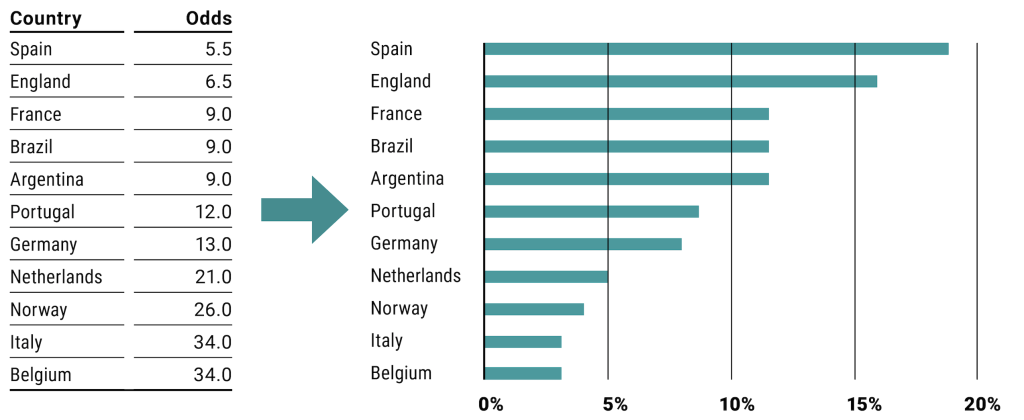
Source: Bet365, ESPN, VIG Asset Management
Status as of 19 March 2026
A new data source for Wall Street
Recently, the Intercontinental Exchange – the operator of the New York Stock Exchange – launched a new data service that gives investors access to changes in event-based odds from the Polymarket platform. These data reveal how collective expectations evolve regarding the probability of various events.
In the world of investing, this represents a new type of sentiment indicator. Just as betting odds in football signal the more likely winner, they can also be used to gauge market expectations around economic or political developments.
Why would wall street use this?
Institutional investors are constantly searching for new sources of information that can help them better understand future market movements and generate excess returns. Insights derived from betting markets may serve as an additional explanatory variable for future outcomes.
Since odds effectively represent probabilities, investors can incorporate them into a framework of expected returns and risk, allowing them to build more informed strategies.
Betting odds and their implied probabilities often provide a surprisingly accurate picture of relative strengths. At the same time, market expectations are gaining increasing attention as indicators of future movements. It is easy to imagine a scenario where major market shifts are not preceded by macroeconomic data releases, but rather by turning points in collective expectations.
Playing with the odds
Let’s imagine that we turn World Cup favorites into an investment portfolio. Countries are represented by equity indices, while their weights are determined by their probability of winning the tournament. As these probabilities change, the portfolio weights adjust accordingly.
The portfolio always consists of the 11 most likely contenders, which are currently as follows:
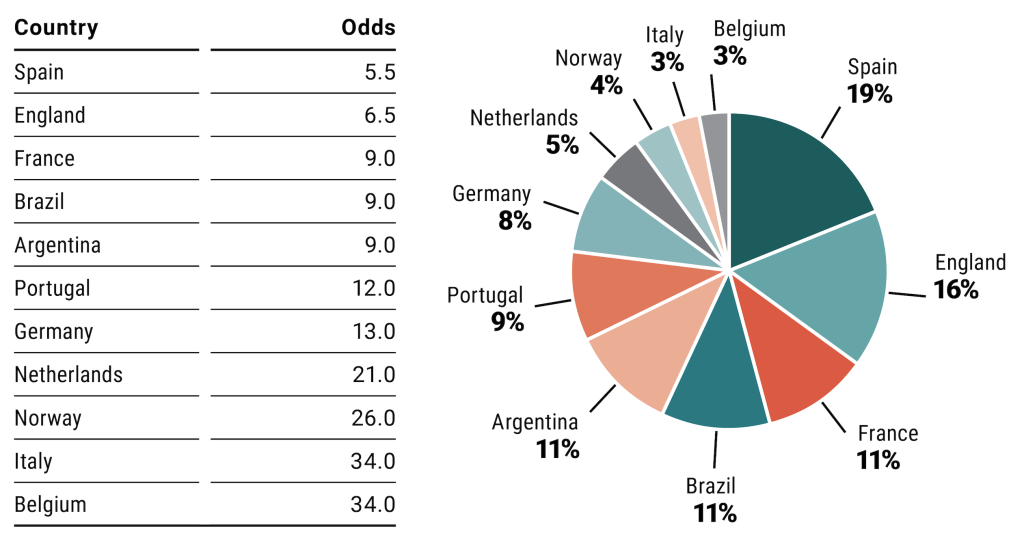
Source: Bet365, ESPN, VIG Asset Management
Status as of 19 March 2026
Overall, this results in a well-diversified hypothetical equity portfolio. It provides exposure to both developed and emerging markets, with a strong tilt toward Europe. This effectively suggests that football fans expect a European country to win this year’s World Cup.
We have been tracking the performance of this hypothetical portfolio since 2025, during which it has delivered notably strong returns:
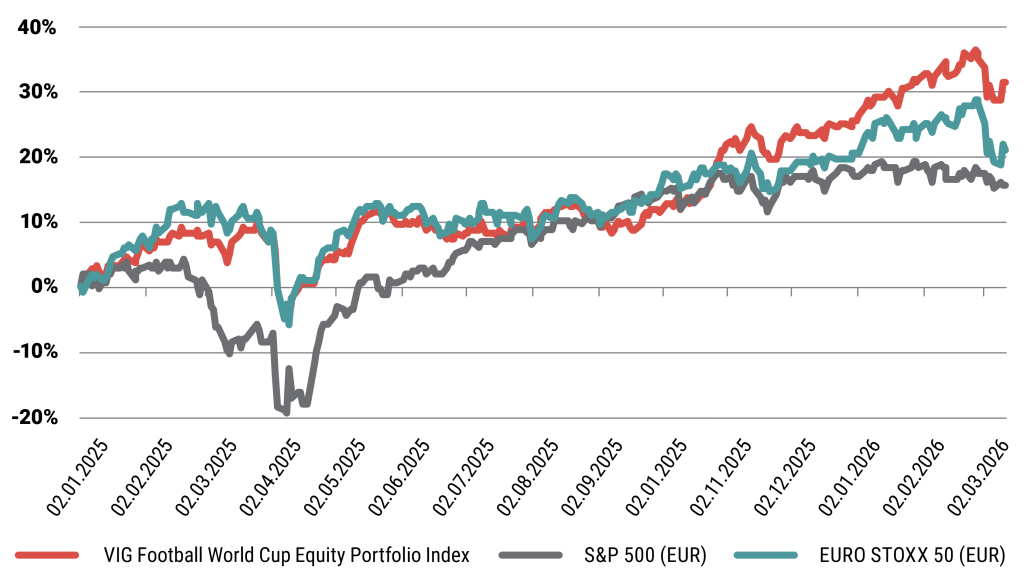
Source: VIG Asset Management
It seems that football fans’ expectations are not entirely unfounded even in capital markets.😎
Stay connected
Would you like to keep up to date with news and insights related to the performance of the VIG Football World Cup Equity Portfolio Index?
Follow us on our social media channels:
The portfolio presented and the related analyses are provided for informational purposes only and do not constitute investment advice, an offer, or a recommendation, nor do they form the basis for any investment decision. The performance presented is based on hypothetical calculations, is for informational purposes only, and does not reflect the past or future returns of any existing investment product.
The construction of the portfolio and the determination of probabilities involve the use of statistical models and methods based on artificial intelligence; any projections or forecasts regarding future performance are not guaranteed.
Legal Notice: The operator of this blog is VIG Asset Management Hungary and the authors are employees of the Asset Management Company. This website contains commercial communication. The articles published on the blog reflect the subjective opinions of private individuals, are prepared for informational purposes only, and do not constitute investment analysis or investment advice, nor do they contain any investment recommendations. The authors of the blog may trade in their own name in financial instruments, funds, or other products about which they provide information or express an opinion in their articles. While the authors’ experience gained in stock exchange or over-the-counter trading may be reflected in their writings on this blog, such interests must not influence the information they provide. Articles, news, and information on the blog may feature companies that maintain business relations with VIG Asset Management Hungary or with the authors of the blog, either directly or through another company belonging to the VIG Group. The articles published on this blog do not provide complete information and do not replace the assessment of the suitability of an investment, which can only be determined by evaluating the individual circumstances of the given investor. To make a well-founded investment decision, please seek detailed information from multiple sources.
VIG Asset Management Hungary, the editors, and the authors of the blog accept no responsibility for the timeliness, possible omissions, or inaccuracies of the content on the blog, nor for any investment decisions made on the basis of the blog articles, or for any direct or indirect damage or cost arising from such investment decisions.