Degree, expectations, reality: why the value of education doesn’t always show up in wages

In Hungary, a university degree has long meant more than just a ticket to the labor market: it also represents status and security.
In many families, it signals not only that “you have a qualification,” but also that it will be easier to change jobs, that you will have greater mobility, and that you will be less dependent on the fate of a single employer.
The chart below illustrates one structural reason behind the tension between these expectations and today’s reality: although the share of university graduates in Hungary has steadily increased over the past decades, the country’s convergence in hourly labor productivity relative to the EU average has progressed at a much slower pace.
The share of graduates has increased, but the convergence of hourly labor productivity has remained slower in Hungary.
The share of graduates has increased, but the convergence of hourly labor productivity has remained slower in Hungary.
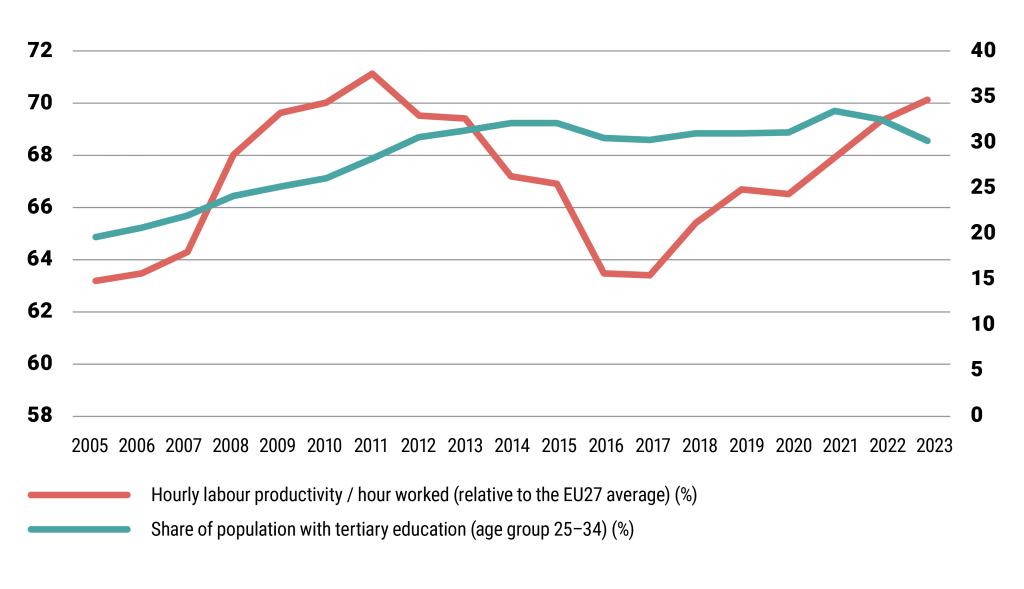
Source: Eurostat, VIG Asset Management
But to understand why the social belief in the value of a degree became so strong, it is worth going back to the period of the political transition.
Why did this perception emerge? The transition as a turning point
Until the late 1980s, life in many towns revolved around one or two large employers: a factory, a mine, or an industrial plant. These workplaces did not only provide wages; they also offered a career path. You learned the job, gained experience, became a skilled worker, and over time you could move up.
After the political transition, however, many people realized that this world was not merely becoming “temporarily more difficult” – it could disappear entirely. For many families, this created a dilemma that had been largely unknown during the socialist era: what will we live on next month?
Until the transition, work provided rhythm and predictability. You knew when your shift started, how much you would earn at the end of the month, and if you worked properly, there was at least some sense of a future.
When conversations changed: from pay rises to simply having a job
Closures, layoffs and the disappearance of orders arrived quickly. Suddenly, conversations were no longer about whether wages would increase, but about whether there would be work at all.
Unemployment became deeply personal for large parts of society. Familiar faces disappeared from shifts, neighbours lost their jobs, and in many families fathers came home with the news that there would be no shift tomorrow – they would be notified later.
This was not only financial insecurity. It was also the realization that a life path that had once seemed stable could lose its foundation overnight. Many families experienced that even if someone worked diligently and was skilled at their job, they could still become vulnerable if the factory closed because orders disappeared.
From this perspective, it is understandable that the message to the next generation gradually changed. It was no longer simply “work hard,” but also: obtain a qualification that allows you to change direction more easily if the world around you changes again.
“Make sure you have a degree”
From this experience emerged a generational reflex: get a degree. Not necessarily because it promised automatic wealth, but because it offered greater flexibility – more doors open, easier job changes, or even moving to another city. It also created the sense that a family’s future would not depend entirely on the fate of a single factory.
For many families, a university degree therefore became more than just a qualification. It became a form of insurance against vulnerability, or at least the hope that if things went wrong, having a degree would leave more options open.
For a long time this logic was rational, and to some extent it still is. However, the labour market has changed. In many places the degree has remained an entry requirement, while it does not always come with real decision-making power, higher responsibility, or a significantly better wage trajectory.
And this is where today’s tension begins: the social promise still exists, but the reality of many jobs no longer reflects it.
Why do many people feel that “a degree does not pay”?
The social promise of a degree – greater flexibility, higher responsibility and better wages – often no longer matches the reality of many positions advertised as “graduate jobs.”
In an increasing number of office roles, much of the work consists of standardized execution: administration, coordination, reporting and internal operational tasks.
This is where the dissonance becomes visible. You invest years into education, yet often receive little more autonomy or income potential than in a trainable office role.
Why do employers require degrees for jobs that may not truly need them?
In many cases, it is simply a selection technique. When hundreds of candidates apply for a position, a degree works as a quick filter. It does not necessarily mean someone will perform better, but it signals a higher probability of certain baseline capabilities.
Employers often interpret a degree as a signal of discipline, resilience, information-processing ability, faster learning capacity and adaptability. In many HR processes, therefore, the degree is less a guarantee of knowledge and more a signal that reduces hiring risk.
What separates a “nice-sounding” graduate job from a truly valuable one?
Not the title – but three conditions.
The first condition: an ownership mindset
At this level, the job is no longer only about ticking off tasks, but also about responsibility for outcomes. Not just whether something was done, but whether doing it actually improved anything.
Here a fundamental shift in thinking appears: from task to objective.
In an execution role, work looks like this: “tell me what to do.”
In an ownership role, it looks like this: “here is the goal and the framework – find the best way to achieve it.”
This is the point where a degree truly starts to work, because theoretical knowledge and structured thinking become tangible value.
Why is this less common in many Hungarian companies?
Because the conditions for ownership responsibility are often missing. Operations are frequently organized around firefighting, decisions arrive from above, and responsibility easily becomes diluted. If something gets stuck, it is often easier to pass it on than to carry it through.
This can be reinforced by lower trust levels between employees and a more cautious workplace culture. If initiative carries risk, people learn that it is safer to execute tasks flawlessly than to take responsibility for outcomes.
If good performance means “don’t create problems,” avoid debate and do not challenge processes, then understandably few people volunteer to drive change – especially because the first weeks of any change are almost always noisy and uncomfortable.
The second condition: measurability
The second condition is measurability. Without measurement, “efficiency improvement” easily becomes a matter of who can argue their position more convincingly.
A complex KPI system is not necessary. A few simple indicators that everyone understands are enough: lead time, error rates or the number of complaints. Without these, we can only say “I think it improved,” but we cannot prove that it actually did.
This also connects directly to wages. In most companies, salary increases are not granted for intentions but for impact. If you can demonstrate that a change reduced lead time or error rates, you effectively generated or saved money.
In that case, salary negotiations become less impression-based and more clearly a business discussion.
Why does this not work everywhere?
In theory it would be simple to link pay to measurable impact. In practice, however, many Hungarian companies lack the basic infrastructure needed for this.
This infrastructure does not necessarily mean expensive IT systems. It primarily means having a clear understanding of business processes and defining them in a way that everyone understands.
If it is not clearly stated where a process begins and ends, even the most basic metrics become subjects of debate. One team believes lead time starts when the customer request arrives, another when it is recorded, and a third when approval is granted.
In such cases measurement becomes less a compass for better decisions and more a source of argument.
The third condition: decision space
Not everyone needs to participate in preparing the company’s most strategic decisions, but some room for action is necessary.
Decision space means that your work does not stop at “I noticed the problem.” It means you also have the opportunity to contribute to the solution. A lack of decision space often looks like this: even small changes become disproportionately bureaucratic. Rewriting a template requires multiple approvals, IT requests travel through several layers, and by the time anything happens, attention has already shifted to the next urgent problem.
In such an environment, graduate roles easily shrink to maintaining operations – even when employees clearly see where improvements could be made.
This is when knowledge, responsibility and the ability to act become separated. You recognize the problem and may even see the solution, but you lack the authority or tools to change it.
And where graduate work cannot consistently contribute to improvements, simplification and better decisions, higher wages cannot sustainably spread either.
The root of the issue: the wage premium ultimately depends on productivity
Sustainable wage differences do not emerge from education alone, but from productivity – from how many jobs exist in an economy where knowledge translates into measurable added value.
In other words, graduate wages do not rise simply because we say “knowledge should be valued,” but because companies are able to create more value from each hour of work.
There is still significant catching up to do. According to a 2022 report by the European Commission, Hungarian labour productivity was 32% below the EU average (adjusted for price level differences).
This number also sets the ceiling for the graduate wage premium. If a company produces less value per hour worked, it simply cannot sustain higher wage levels – even if it would like to.
The opposite is also true. When productivity increases, more value is created in the economy and more roles emerge where graduate employees can take on greater responsibility, decision-making authority and process improvement tasks.
A degree truly becomes valuable where employees are not only executing tasks but are responsible for outcomes, can see the impact of their work, and have the opportunity to improve how things operate.
Productivity growth does not necessarily begin with large, spectacular reforms. It often starts with small but scalable steps: clearer processes and responsibilities, meaningful feedback, automation and better management practices.
In this sense, the graduate wage premium is not a question of policy intention but a consequence of productivity. It will increase when companies operate more effectively, invest more in development, improve their processes in measurable ways, and create more positions where graduate knowledge is paired with real responsibility and room for action.
If the lesson of the political transition was the importance of “having a certificate,” then the lesson today may be that the value of a degree ultimately depends on whether the economy can create jobs where the knowledge behind the diploma becomes measurable value creation.
Legal Notice: The operator of this blog is VIG Asset Management Hungary and the authors are employees of the Asset Management Company. This website contains commercial communication. The articles published on the blog reflect the subjective opinions of private individuals, are prepared for informational purposes only, and do not constitute investment analysis or investment advice, nor do they contain any investment recommendations. The authors of the blog may trade in their own name in financial instruments, funds, or other products about which they provide information or express an opinion in their articles. While the authors’ experience gained in stock exchange or over-the-counter trading may be reflected in their writings on this blog, such interests must not influence the information they provide. Articles, news, and information on the blog may feature companies that maintain business relations with VIG Asset Management Hungary or with the authors of the blog, either directly or through another company belonging to the VIG Group. The articles published on this blog do not provide complete information and do not replace the assessment of the suitability of an investment, which can only be determined by evaluating the individual circumstances of the given investor. To make a well-founded investment decision, please seek detailed information from multiple sources.
VIG Asset Management Hungary, the editors, and the authors of the blog accept no responsibility for the timeliness, possible omissions, or inaccuracies of the content on the blog, nor for any investment decisions made on the basis of the blog articles, or for any direct or indirect damage or cost arising from such investment decisions.