The model portfolios have been constructed based on the VIG Investment Clock and our tactical asset allocation strategy, using following principles: we have selected 4-5 investment funds from our own range.
In all three currencies, the Conservative Portfolio targets a composition of 40% equities and 60% bonds, while the Dynamic Portfolio focuses on 60% equities and 40% bonds. The key economic factors behind these allocations include global and regional economic trends, expectations of central bank interest rate cuts, and investor sentiment.
Conservative portfolio focuses more on stability and fixed income assets (bonds), whereas dynamic portfolios aim for higher-yield outlook, using the volatility of equities. Conservative portfolios tend to focus on stability and safer assets (bonds), while aggressive portfolios rely on higher-yielding but riskier equities. In its investment decisions, VIG Fund Management pays close attention to sustainability, particularly in ESG and sustainable funds.*
Investment Approach
The science-based VIG Global Investment Clock, which forecasts economic cycles using indicators, remained firmly in the expansion phase in November 2026. The model’s forward-looking indicators point to a slight strengthening of economic growth and a modest rise in energy-driven inflation. And steadily so: unlike in the earlier uncertain months, the indicator did not jump between phases but remained consistently within this range. In the United States, amid slowing job creation and stable economic activity, the Fed kept rates on hold, while in Europe the ECB remained cautious given the burden high gas prices place on industry.
At the same time, there is a significant divergence between macroeconomic data and actual market pricing, as moves across asset classes deviate from the theoretical model. In equity markets, rising oil prices and the sell-off in the technology sector have produced a stagflationary sector rotation instead of expansion. In China, inflation is being shaped by two opposing factors. While falling food prices and rents are pushing the index down, higher energy prices largely offset this effect. The country’s main goal at present is to leave the earlier deflationary environment behind for good.
VIG EUR Portfolios
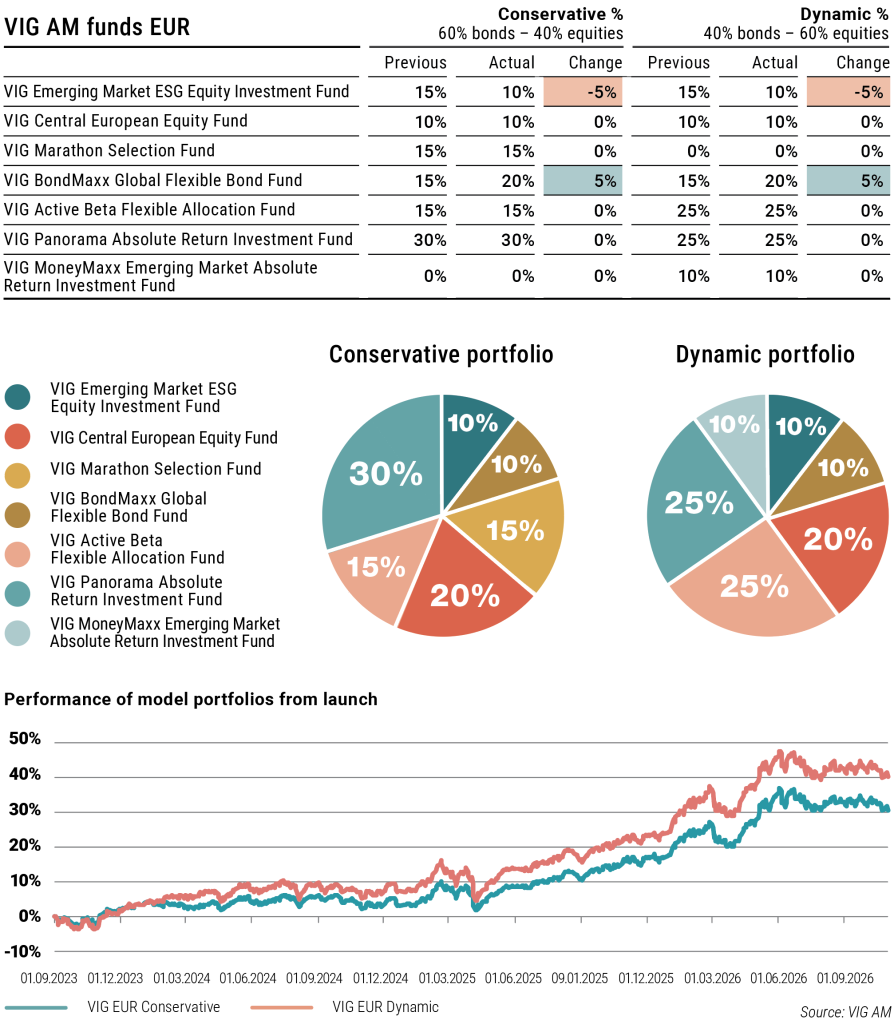
We made changes similar to those for the forint funds in both of our euro model portfolios, which carry different levels of risk exposure. In both the more cautious “prudent” portfolio and the “dynamic” portfolio, which follows a bolder investment policy, we reduced the share of the VIG Emerging Markets ESG Equity Investment Fund, which has significant Asian tech exposure. Although the valuation discount of Asian markets remains favourable, we considered a cautious reduction of the weights justified in light of the increased risks. We did, however, increase the weight of the VIG BondMaxx Total Return Bond Investment Fund, which invests in global bond markets, primarily in longer-dated developed market bonds that have particularly good prospects in the current yield environment. The largest portfolio holdings are the inflation-“fighting” VIG Panoráma Fund and the VIG Active Beta Flexible Allocation Fund, which invests in the most popular developed market equities (most recently in the energy sector).
VIG USD Portfolios
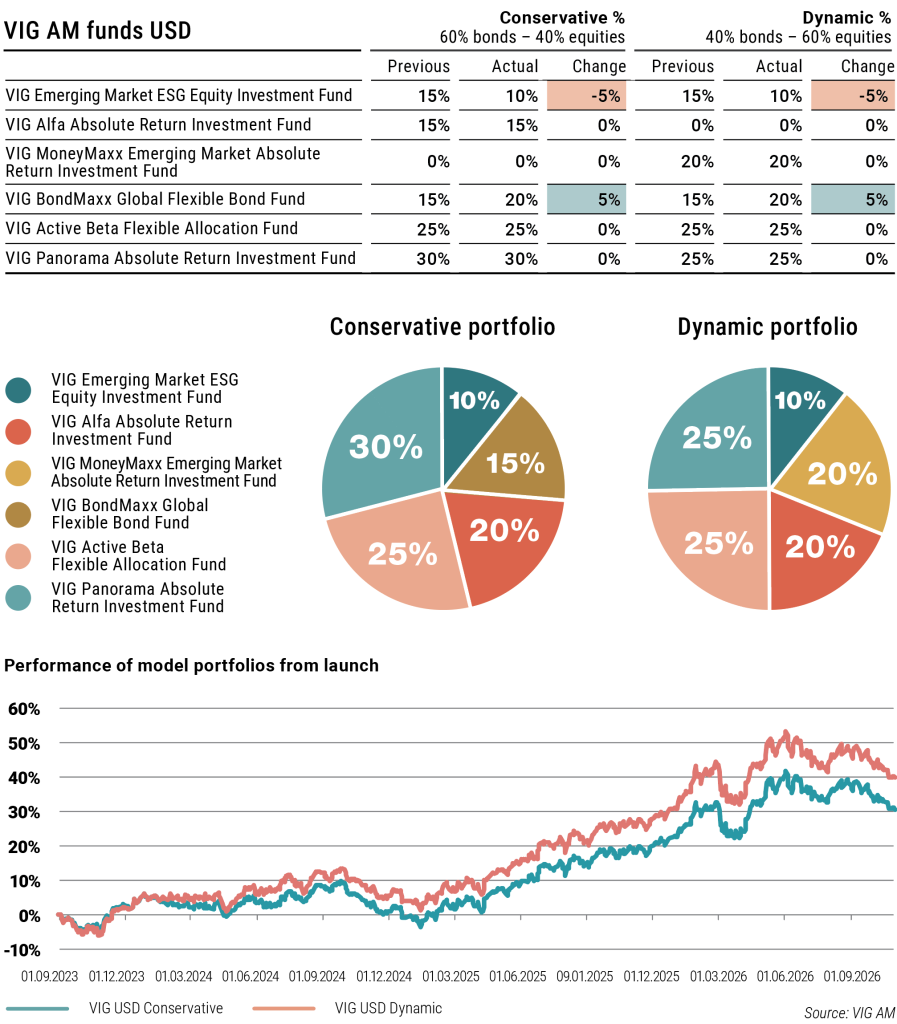
In the dollar portfolios, too, we made changes corresponding to those in the euro portfolios. Our caution regarding the VIG Emerging Markets ESG Equity Investment Fund is justified by our reservations about the share prices of Asian companies, primarily those linked to the AI boom, and by the previously mentioned strengthening of the dollar. The increase in the weight of the actively managed VIG BondMaxx Global Flexible Bond Fund is justified by developed market bond yields at multi-decade highs, which provide investors with an excellent entry point and an attractive yield buffer. The largest portfolio holdings remain the VIG Panoráma Fund (which protects against inflation) and the VIG Active Beta Flexible Allocation Fund (which contributes to portfolio performance through the best developed market equity investments).
Detailed information on the consideration of sustainability aspects is available on our website: https://www.vigam.hu/en/esg-investments/
Disclaimer
This is a distribution announcement. Detailed information is needed to make a well-founded investment decision. Please inform yourself thoroughly regarding the Fund’s investment policy, potential investment risks and distribution in the Fund’s key investment information, official prospectus and management regulations available at the Fund’s distribution outlets and on the website of VIG Asset Management Hungary Closed Company Limited by Shares (hereinafter: Asset Management) (vigam.hu). The costs related to the distribution of the fund (buying, holding, selling) can be found in the fund’s management regulations and at the distribution outlets. Past returns do not predict future performance. Please note that in comparison with other investment funds, the return achieved may be affected by differences in the reference index and therefore the investment policy.
The future performance that can be achieved by investing may be subject to tax, and the tax and duty information relating to specific financial instruments and transactions can only be accurately assessed on the basis of the individual circumstances of each investor and may change in the future. It is the responsibility of the investor to inform himself about the tax liability and to make the decision within the limits of the law.
The information contained in this leaflet is for informational purposes only and does not constitute an investment recommendation, an offer or investment advice. Asset Management accepts no liability for any investment decision made on the basis of this information and its consequences.
This leaflet may contain trade names or brand names owned by third parties, the use of which serves illustration purposes only. All product and company names are trademarks™ or registered trademarks® of their respective owners. The use of such trademarks does not imply any business or other relationship between Asset Management and the owners of the trademarks, nor shall it be interpreted as a recommendation by Asset Management.
The Asset Management’s license number for managing alternative investment funds (AIFM) is: H-EN-III-6/2015. The Asset Management’s license number for UCITS fund management (collective portfolio management) is: H-EN-III-101/2016.